


I still remember standing at a tyre shop, running my finger along a sidewall, trying to find the tyre manufacturing date for the first time. Back then I only checked brand, size, tread, and price, like most buyers. Nobody told me a tyre is a safety part whose rubber ages quietly over time. Whether you drive a car or ride a bike, tyres keep ageing even when the vehicle sits parked.
Sunlight, humidity, and oxidation work on rubber slowly, which is why the tyre manufacturing date matters as much as how the tread looks. Learning to read this code takes only a minute once you know where to look. In this guide, I will walk you through finding it, decoding it, and using it to judge real tyre age.
Why Tyre Manufacturing Date Matters
Every tyre is built from rubber and chemical compounds that age naturally after leaving the factory. Heat, oxygen, and moisture slowly work on rubber, which is why even a stored tyre can deteriorate.
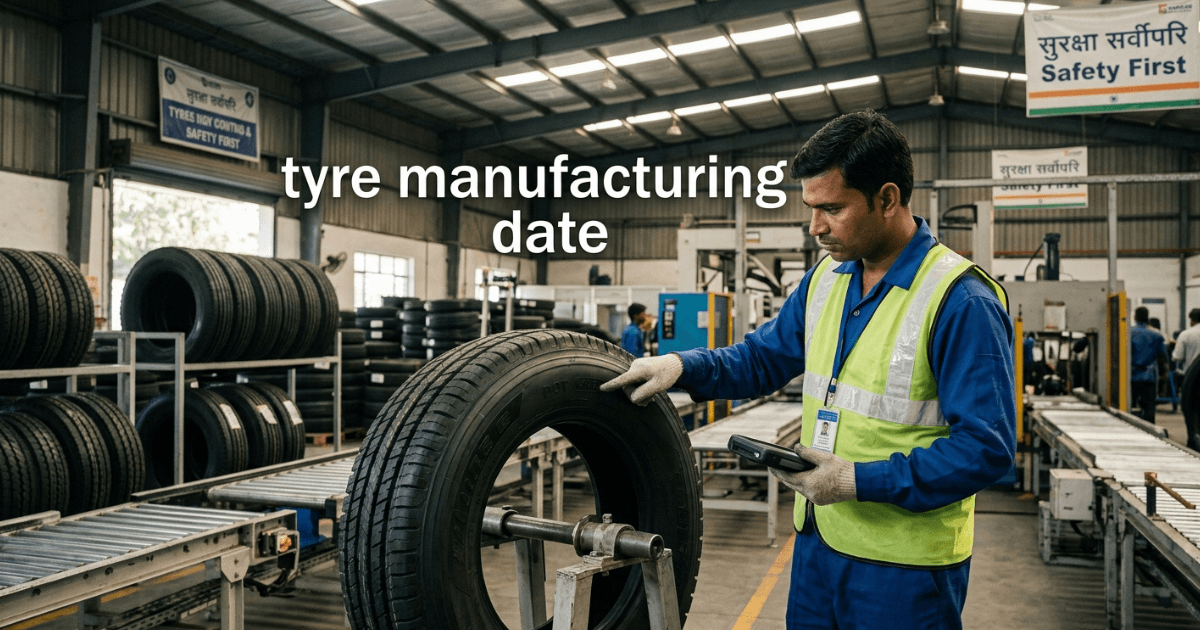
In India, high summer temperatures speed up hardening and reduce grip faster than most owners expect. This is exactly why checking the tyre manufacturing date before buying makes sense.
Poor storage, direct sunlight, and damp conditions only make ageing worse. Manufacturers like Bridgestone have warned that long inactivity and careless handling lead to cracking and a shorter usable life. From experience, always prefer recently manufactured tyres over shelf-aged ones. Knowing the tyre manufacturing date rarely lets a tyre surprise you with sudden failure.
Where to Find the Tyre Manufacturing Date
Finding the tyre manufacturing date feels confusing at first, but the pattern is easy once you know it. Walk around the tyre and check both sidewalls closely. Near the valve area or close to the brand name, you will spot a cluster of letters and numbers inside a small outlined section. This cluster includes the DOT marking, load rating, and pattern information.
Good lighting helps a lot, since the raised or molded numbers can be hard to read in a dim garage. Most major brands, including Bridgestone, place this marking the same way. At the very end of this code sits the part you need: a four-digit number showing the production week and year. If one sidewall looks worn, check the inner sidewall instead.
How to Decode the Tyre Date Code
Reading the code is simple once you understand the WWYY format. The first two digits show the week of manufacture, and the last two show the year. Take code 1026: the 10th week points to early March, and 26 points to 2026. Try 5225, and you get the 52nd week of 2025.
A code like 3421 breaks down into the 34th week of 2021, and 0619 breaks down into the 6th week of 2019. Bridgestone notes that week fell between February 4 and 10. Once you practise on a few tyres, splitting any tyre manufacturing date code into these pairs becomes second nature.
Tyre Date Code Examples
Seeing real examples makes this click faster. Code 1026 means the 10th week of 2026, code 2526 means the 25th week of 2026, and code 4025 means week 40 of 2025. On another tyre, code 0522 works out to week 5 of 2022, code 2419 becomes week 24 of 2019, and code 4320 becomes week 43 of 2020.
Code 5118 becomes week 51 of 2018, and 3421 becomes week 34 of 2021. Recent examples include 0524 as week 5 of 2024, 1823 as week 18 of 2023, 3024 as week 30 of 2024, and 4725 as week 47 of 2025. This simple system never changes.
Does a New Tyre Need to Be Recently Manufactured?
Not every tyre needs a very recent production date to be safe. A tyre made a few weeks or months before purchase is not automatically unsafe, especially with proper storage.
The real risk comes from poor storage, where heat, humidity, or sunlight speed up deterioration. When comparing similar tyres, choosing the newer one is simply a smart precaution. I always ask how long stock has been stored, because knowing the actual tyre manufacturing date helps judge freshness better than guessing.
Tyre Lifespan, Age Limits and When to Replace
A tyre’s real life depends on more than one number. Tread depth, usage, mileage, driving style, climate, and storage history all decide how long a tyre stays safe.
Cracks, sidewall damage, uneven wear, and bulges can appear even on a rarely driven tyre. Hardening brings reduced grip, and once wear hits an excessive stage, replacement stops being optional.
Bridgestone Australia suggests removing tyres after 10 years from the tyre manufacturing date, regardless of appearance, and recommends yearly checks after five years. Whenever I see repeated repairs on a tyre’s history, I treat it as a warning sign. A tyre professional can always confirm whether its age means replacement is due.
Checking Tyre Condition Beyond Just the Date
A good date check means nothing if you skip the rest of the tyre. Start with tread pattern and wear indicators, since 1.6 mm is the legal minimum and 2 mm is a safer replacement point. Run your fingers over both sides for cracks, weathering, and scrapes that can grow worse with time. A bulge usually points to internal damage that deserves a proper look.
Uneven wear often traces back to alignment issues or suspension problems. Watch for punctures, valve problems, or frequent pressure loss, since these cause real safety risks over time.
Bridgestone recommends attention to unusual vibration or noise too. I personally check sidewall condition, tyre pressure, and storage history together, since wet roads expose weak tyres fastest.
Simple Ways to Take Care of Your Tyres
Good habits protect tyres better than any single check. I keep tyre pressure at the level the manufacturer suggests, since under- or over-inflation hurts handling, braking, and comfort. If the car pulls to one side, or I notice strange wear patterns, I book a wheel alignment check right away. Vibrations through the steering wheel usually point to a balancing issue.

Following a proper rotation schedule spreads wear evenly, and I always pair that with a visual inspection for cracks, cuts, and bulges. Overloading places extra strain on rubber too. Any damaged tyre gets replaced immediately, and I avoid parking for long spells in direct sunlight or harsh heat.
What to Check Before Buying New Tyres
Before paying for a new set, I run through a short checklist. I confirm the brand, model, correct size, and load rating needed for my car. Next, I locate the identification marking on the sidewall and read the tyre manufacturing date covering the production week and year. I also look for cracks, damage, or visible deterioration.
Final Thoughts
The tyre manufacturing date matters just as much as the tread you can see. Reading the code on the sidewall takes barely a minute, whatever year it shows. But tyre safety never rests on age alone.
Tread depth, storage conditions, tyre pressure, alignment, and overall condition all deserve equal attention alongside the tyre manufacturing date. Whether you drive a car or ride a bike, road grip, braking, and stability depend on this small routine. A trustworthy manufacturer builds tyres around clear service limits.
FAQs
What is a tyre manufacturing date?
It is a four-digit code stamped on the sidewall showing the exact week and year a tyre was produced, usually in WWYY format.
How do I read a tyre manufacturing date code?
Split the four digits into two pairs. The first two digits are the production week, and the last two are the production year, such as 1026 meaning week 10 of 2026.
Why does the tyre manufacturing date matter when buying tyres?
Rubber ages over time due to heat, sunlight, and storage conditions, so checking it early helps you avoid a tyre that is already old before you even fit it.
How old is too old for a tyre based on manufacturing date?
Many manufacturers, including Bridgestone Australia, suggest replacing tyres around 10 years from the tyre manufacturing date, and having tyres over five years old inspected annually.
Where exactly is the tyre manufacturing date located?
Look on the tyre sidewall near the DOT marking or identification number. The tyre manufacturing date appears as the last four digits of that code, often inside a raised outlined section.