

Winter tires are rarely sitting on the rack in Baton Rouge, LA, but you can still get a set if you know where to ask and when to order. Most local shops stock all-season tires because winters here are usually mild. The January 2025 storm proved that snow and ice can still shut the city down.
This guide answers the questions drivers actually ask: do you need them, what makes them different, which local tire shop can source them, and what they cost. Each section opens with a short answer, so you can skim to what matters.
Do You Really Need Winter Tires in Baton Rouge?
Most Baton Rouge drivers do not need winter tires every year, because January nights average about 43°F. They make sense if you must drive during a freeze, travel north for work or holidays, or own a truck that slides easily. Think of a winter set as insurance for rare but serious icy conditions.
On January 21, 2025, Baton Rouge recorded 7.6 inches of snow, its snowiest day since records began in 1892, and the airport hit 7°F the next morning. With no large snowplow fleet, the region waited for the sun to clear icy roads.
If you must drive in a freeze, a dedicated set gives you far better traction and control.
Who benefits most from a winter set?
Drivers who head to colder states for holidays, ski trips or work get the most value. So do nurses, utility crews and delivery drivers who must cross frozen bridges and overpasses. Owners of rear-wheel-drive trucks benefit too, since an empty truck bed puts little weight on the drive wheels.
Bridges and overpasses freeze before regular roads because cold air flows above and below them. Interstate 10 ramps in Baton Rouge closed during the 2025 storm, which pushed traffic onto side streets. A winter set will not make those roads safe, but it gives you more grip if you have no choice.
What Makes Winter Tires Different From All-Season Tires?
Winter tires use a soft tread compound that stays flexible below about 45°F, the point where all-season rubber starts to stiffen. They also have deeper grooves and many thin slits called sipes, which form biting edges on snow and ice. Together, these give shorter stops and steadier handling in the cold.
Tire sellers such as Discount Tire use 45°F as the rule of thumb for switching. Below that, all-season rubber gradually hardens, so braking, accelerating and cornering get less reliable, even on dry pavement. A winter tire keeps its grip because the rubber can still mold to tiny bumps in the road.
What does the 3 Peak Mountain Snowflake symbol mean?
The 3 Peak Mountain Snowflake (3PMSF) symbol on a tire’s sidewall means the tire passed a standard snow traction test. Tires with it are often described as Severe Snow Rated. A plain M+S (mud and snow) mark only describes the tread shape, so look for the snowflake if you want proven winter performance.
Some all-weather tires also carry the 3PMSF mark. They sit between a dedicated winter tire and an all-season tire, and you can leave them on year-round. For a city that sees snow once every few years, an all-weather tire is a reasonable middle ground worth asking about.
What tread features should you look for?
Look for high sipe density, a flexible tread compound, and grooves that push slush and water out to the sides. These features help with snow compaction, water evacuation and ice braking performance. Each brand uses its own names, but the goals are the same across models.
For example, the Falken WINTERPEAK F-ICE 1 uses 3D Canyon Sipe Technology, 4D Nano Design Technology, and curving grooves that lead to wide shoulder openings. The Continental ContiCrossContact Winter lists strong traction on snowy and wet roads and protection against aquaplaning. Wet grip matters here, since January is one of Baton Rouge’s rainiest months.
Should you buy studded tires in Louisiana?
Most Baton Rouge drivers should skip studded tires. Studs help on solid ice, but they are noisy and lose grip on bare, wet pavement, which is what you drive on most winter days here. If you buy a studdable winter tire, ask your shop about current Louisiana rules before adding studs.
The Falken WINTERPEAK F-ICE 1 is one example of a studdable design that also works without studs. Running it studless keeps the option open if you later move to a colder state. For local driving, the tread and compound do most of the work.
Where Can You Find Winter Tires in Baton Rouge?
Your best bet is a full-service tire dealer that can order from a distributor, since few Baton Rouge stores keep winter tires in stock. Call ahead with your exact tire size and ask how long delivery takes. Ordering online and booking local installation is a solid second option.
Which local shops can help you source them?
Several shops in and near Baton Rouge show winter tires or winter tire advice on their websites. 360 Automotive Solutions lists the Continental ContiCrossContact Winter in its online tire catalog, and K & M Automotive covers winter traction in its tire buying guide. Call first, because an online listing does not always mean the tire is on the rack.
| Shop | Address | Phone | What its website shows |
| 360 Automotive Solutions | 1334 Florida Blvd, Baton Rouge, LA 70802 | (225) 344-9586 | Continental ContiCrossContact Winter in sizes 215/60R17 to 255/65R16; Goodyear, Dunlop and Kelly brands |
| K & M Automotive | 8445 Siegen Ln, Baton Rouge, LA 70810 | 225-636-2875 | Michelin, Bridgestone, Cooper and Goodyear; rotation and pressure advice for winter tires |
| Total Performance Tire Pros | 7786 Hwy 61, Saint Francisville, LA 70775 | (225) 635-8090 | Continental, General, Pirelli, Hercules and Toyo; price match and financing |
360 Automotive Solutions is part of the Goodyear Tire & Service Network (TSN). Tire Pros in Saint Francisville, LA also serves New Roads, LA and Jackson, LA, which helps if you live north of the city.
Can you buy winter tires online and install them locally?
Yes. Many online retailers sell dedicated winter tires and ship them to your home or to a partner installer. Before you order, call a local shop to confirm it will mount tires you bring in, and ask the price for mounting, tire balancing, a new valve stem and disposal of your old tires.
Buying online lets you compare models, the load index and the speed rating side by side. Keep the receipt and the tire’s paperwork, since any warranty claim may go through the online seller rather than the installer.
How Do You Choose the Right Winter Tire for Your Vehicle?
Start with the size printed on your current tires or on the sticker inside the driver’s door. Match the load range and a speed rating your vehicle allows, then choose a model with the 3PMSF symbol. Finally, buy a full matching set of tires so all four wheels grip the same way.
How do you read a tire size?
A size such as 215/65R16 tells you three key things. The 215 is the section width in millimeters, 65 is the aspect ratio (sidewall height as a percentage of width), and 16 is the rim size in inches. The load index and speed rating follow, for example 100T.
An XL (extra load) marking means the tire can carry more weight at a higher inflation pressure. If your current tires are XL, stay with XL when you buy winter tires.
Can you mix winter tires with all-season tires?
No. Putting winter tires on only the front or rear gives your car uneven grip, which can lead to a spin when you brake or turn on ice. K & M Automotive’s tire FAQ says the same thing: never mix winter tires with all-season or summer tires. Install all four at once.
The same shop also advises against mixing run-flat tires with regular tires. If you must replace one winter tire after damage, match the brand, model and tread depth as closely as you can.
Should you buy a second set of wheels?
A second set of wheels makes seasonal swaps faster and cheaper over time. Instead of paying to dismount and remount tires twice a year, you simply swap wheels. Steel wheels usually cost less, and your shop can confirm the right bolt pattern, wheel offset and rim width for your car.
If your car has a tire pressure monitoring system, the second set needs sensors too, or the warning light will stay on. Ask about TPMS service when you get your quote. Some shops can program new sensors to match your car during installation.
How Much Do Winter Tires Cost in Baton Rouge?
Prices depend on size, brand and whether the shop has to special-order the tire. As one real example, JEGS listed the Falken WINTERPEAK F-ICE 1 in size 205/55R16 at $112 per tire at the time of writing. Larger SUV and truck sizes usually cost more, so always get a written quote.
The tire price is only part of the bill. Tire installation often adds charges for mounting, balancing, valve stems, disposal and sometimes TPMS sensors. Ask for an “out-the-door” price for all four tires so you can compare shops fairly.
How can you save money on a winter set?
Look for tire rebates, tire coupons and financing options at local shops. Tire Pros locations, for example, advertise a price match guarantee and no interest financing on qualifying purchases made with their credit card. Shopping before a cold snap also helps, because you can compare quotes without rushing.
The Tire Pros offer, as listed on its site, requires paying in full within 6 months on purchases of $199 or more. Rebates change often, so check each shop’s promotions page right before you buy.
What buyer tips help you avoid a bad deal?
Ask for the exact model, size and price in writing, and confirm whether the tires are in stock or on order. Check the manufacture date on the sidewall, since older stock can sit in a warehouse for a long time. Ask how returns work for special-order tires before you pay.
- Ask whether the tire carries a tire mileage warranty, since terms for winter models often differ from all-season tires.
- Ask whether the shop offers a nationwide warranty if you plan to drive out of state.
How Do You Care for Winter Tires After You Buy Them?
Check the pressure often, rotate on schedule, and take the set off once the cold spell ends. Soft winter rubber wears quickly on warm pavement, and Baton Rouge’s average January high is about 62°F. Store the off-season set somewhere cool, dry and out of direct sunlight.
How often should you check tire pressure?
Check pressure at least once a month and after any sharp drop in temperature. Cold air lowers tire pressure, which can trigger the tire maintenance light on your dashboard. Use a tire gauge and match the recommended PSI on the driver’s door sticker, not the maximum number on the sidewall.
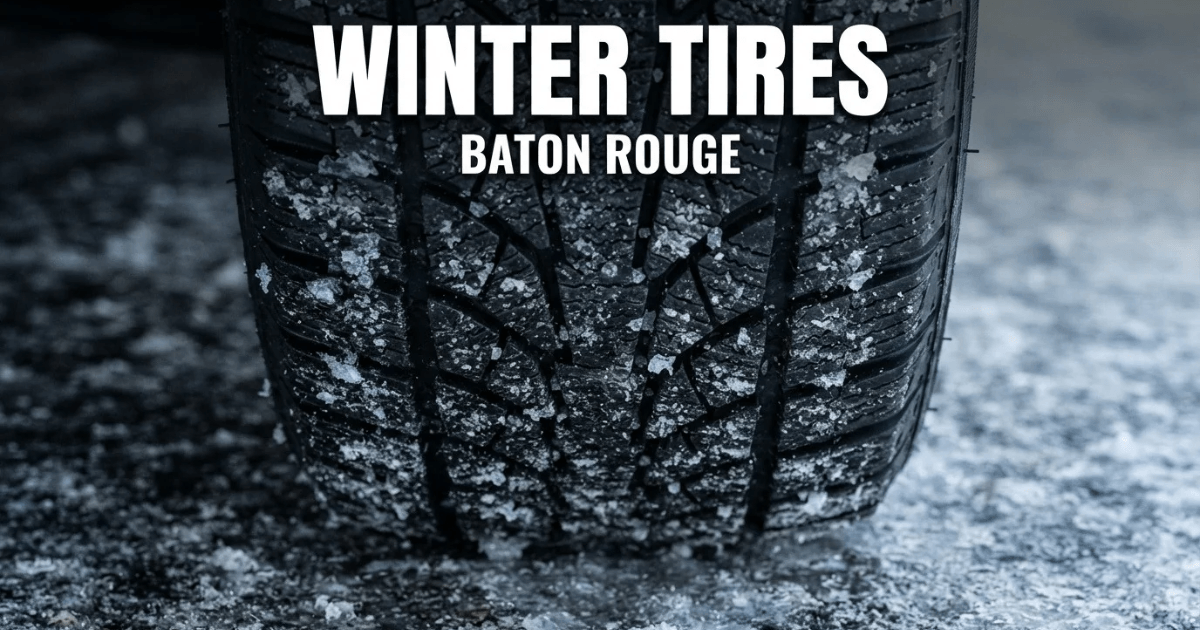
To check it, remove the valve cap, press the gauge onto the stem, and read the number. Low tire pressure reduces grip and wears the edges of the tread faster.
When should you rotate and inspect them?
Rotate winter tires on the same schedule as your regular set, which K & M Automotive puts at roughly every 5,000 to 7,500 miles. Tire rotation keeps tread wear even and preserves grip. At each visit, ask for a tire inspection to spot cuts, bulges, punctures and low tread depth.
For a quick home check, use the penny test: put a penny in a tread groove with Lincoln’s head pointing down. If you can see all of his head, the tread is too shallow and you need new tires. Winter tires lose snow grip well before that point, so replace them sooner if you drive in real snow.
How should you store the off-season set?
Clean the tires, let them dry fully, and store them away from sunlight, heaters and electric motors. Lay tires mounted on wheels flat in a stack, or hang them. Stand tires without wheels upright, and mark each one’s position so you can rotate them when you put them back on.
Tire bags or covers keep dust and moisture away. A garage shelf works well, but avoid a hot attic during a Louisiana summer. If you lack space, ask your shop whether it offers seasonal storage.
Are Winter Tires Worth It in Baton Rouge?
Winter tires are worth it if you must drive during freezes, travel often to colder states, or want the most winter driving safety for a family car. They are probably not worth it if you can stay home for the few icy days most winters bring. Your driving needs matter more than the calendar.
A quick way to decide is to count your “must drive” days. If a freeze would still put you on the road before sunrise, the extra grip in freezing temperatures is worth the cost and storage effort. If not, put that money into a quality all-season or all-weather set and keep it in good shape.
FAQs
Are snow tires and winter tires the same thing?
Yes, for most shoppers the terms mean the same product. “Snow tires” is the older name, while “winter tires” reflects that they help on ice, slush and cold dry roads, not just snow. Both terms usually refer to tires built with a cold-weather compound and the 3PMSF symbol.
Can I leave winter tires on all year in Baton Rouge?
You can, but you should not. Soft winter rubber wears fast in Louisiana heat, and it gives longer stops and softer handling on hot pavement. Swap them back to your regular tires once the cold spell passes, which in Baton Rouge often means within a few days or weeks.
Do all-season tires work in light snow?
All-season tires can handle a dusting on warm roads, but they struggle on packed snow and ice. Their rubber stiffens as temperatures fall below about 45°F, so stopping distances grow. In a storm like January 2025, staying home was the safest choice for drivers without winter tires.
Do winter tires help on cold, rainy roads?
Yes, many do. Models such as the Continental ContiCrossContact Winter list strong braking on wet roads and protection against aquaplaning. Their soft compound and dense siping keep cold-weather grip on chilly, rainy mornings, which Baton Rouge sees far more often than snow.
When should I put winter tires on in Louisiana?
Put them on when a forecast shows several days at or below about 45°F, or when ice or snow is predicted. Book the appointment early, because shops get busy before a freeze. Keep an eye on National Weather Service forecasts for the Baton Rouge area during December through February.