
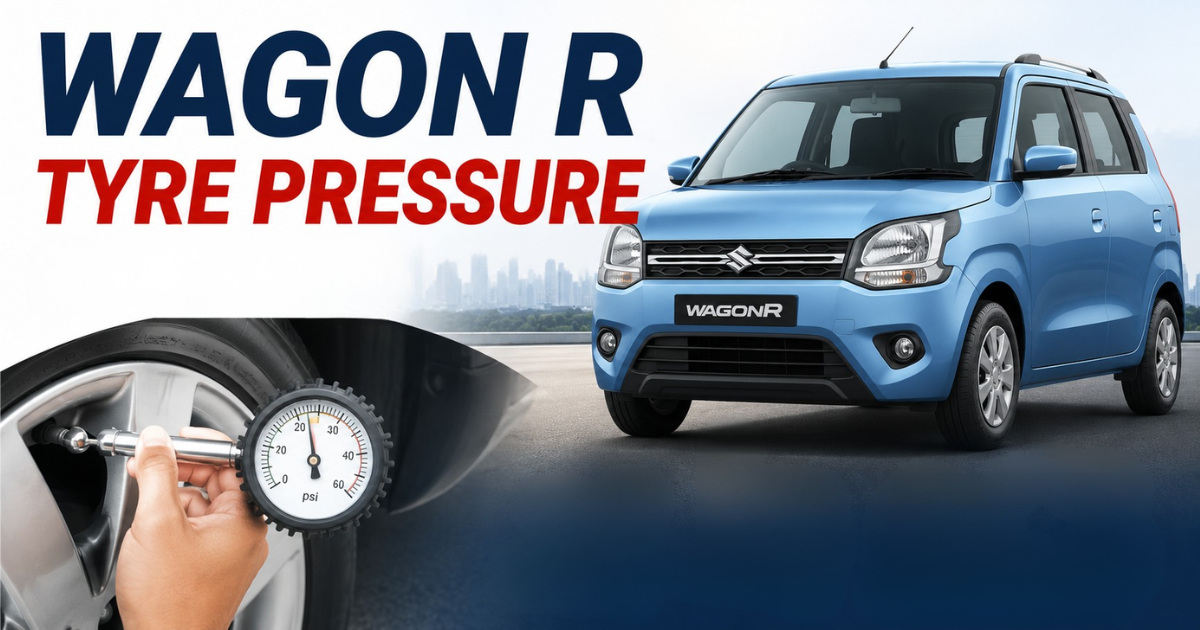
Getting wagon R tyre pressure right protects your mileage, comfort, and safety far more than most owners realize. This guide breaks down the correct figures, tyre sizes, prices, and maintenance tips in one place.
Why Wagon R Tyre Pressure Gets Overlooked?
The Maruti Suzuki Wagon R has built its reputation on being a no-nonsense family hatchback rather than a car that tries to impress anyone. Because of that, most owners never think about wagon r tyre pressure until the ride feels off — and by then they’ve often already been talked into an unnecessary upsell.
This guide covers what actually matters: standard tyre sizes across variants, how to decode sidewall numbers, correct pressure figures, real-world pricing, and when to replace your tyres. The goal is to stop guessing and start deciding based on facts, especially when it comes to tyre pressure.
Much of the problem comes down to trusting whatever number the pump attendant fills in, rather than checking the owner’s manual. That habit slowly eats into fuel efficiency. Correct wagon r tyre pressure also shapes everyday comfort, from how the cabin absorbs bumps to how confidently the car holds a turn.
Decoding the Tyre Size Code on Your Wagon R
The code on a tyre’s sidewall looks intimidating, which is partly why some shops steer customers toward the wrong size.
Take 165/70 R14: 165 is the width in millimeters, 70 is the aspect ratio, “R” means radial construction, and 14 is the rim diameter in inches.
Changing even one of these numbers changes how the car drives and it also changes the ideal pressure for that setup.
Rim size affects cornering, aspect ratio affects ride comfort, and small deviations can throw off speedometer accuracy.
This is worth remembering before agreeing to any casual size upgrade, it directly affects mileage, grip, and correct wagon r tyre pressure down the line.
Variant Wise Tyre Size Breakdown
Not every Wagon R runs on the same tyres. Older generations typically used 145/80 R13, while a mid-tier variant moved up to 155/80 R13. This 155/80 R13 size is still used on today’s base LXI, on 13-inch rims, and it comes with its own recommended pressure setting.
The VXI, ZXI, and top-spec ZXI+ variants typically run 165/70 R14 on 14-inch rims, which slightly changes the ideal pressure too. These are factory choices, selected to balance mileage, cabin noise, and durability for Indian conditions. Petrol and diesel once shared sizing.
All models come with tubeless tyres, which handle punctures more safely and support ABS and Electronic Stability Control. Sticking with the factory size and correct wagon r tyre pressure protects fuel efficiency, keeps the speedometer accurate, and matters for warranty claims. For anyone dealing with heavy city traffic, CNG conversion, or frequent highway trips, the stock size avoids added rolling resistance.
What Happens If You Fit the Wrong Size?
Choosing the wrong tyre size isn’t just a styling decision — it changes how the car behaves and how pressure should be set. Wider tyres might look appealing, but they often bring stiffer steering, reduced mileage, and inaccurate speedometer readings.
Pushing rim size beyond 14 inches without consulting a service center can throw off the car’s balance in every corner. Bigger tyres change ride quality in ways that aren’t always positive — cornering grip may improve, but braking distances can shift.
Straying too far from stock size also complicates pressure settings, since the ideal PSI shifts along with tyre footprint. That said, upsizing isn’t forbidden. Maruti Suzuki permits 175/70 R13 and 165/65 R14 as acceptable upgrades within manufacturer limits. Just remember to recheck your wagon r tyre pressure chart after any such change, since the correct figure won’t stay the same.
Correct Wagon R Tyre Pressure Figures
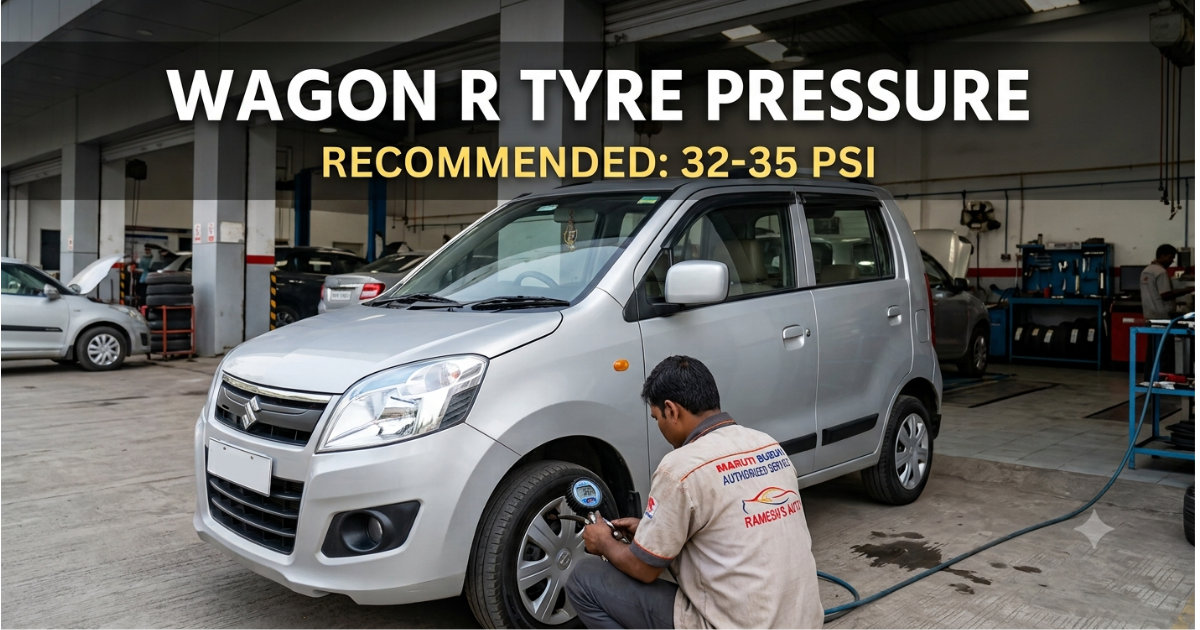
This is where most owners go wrong without realizing it. At the pump, air often gets added with no thought to load or temperature. For a Wagon R under normal, unloaded conditions, the recommended wagon r tyre pressure is generally 30–32 PSI, or roughly 2.1–2.2 BAR.
When the car is fully loaded, this should increase to about 32–35 PSI, or 2.2–2.4 BAR, for correct wagon r tyre pressure. Some sources cite slightly different front and rear figures, such as 36 PSI up front and 32 PSI at the rear.
Always double-check the sticker on your door frame or manual for the exact figure specific to your model. The single most important rule is to measure pressure when tyres are cold — meaning the car hasn’t been driven in at least three hours.
Driving raises tyre temperature, and that alone can push pressure readings up by 4 to 6 PSI, giving a misleading number. Over-inflated tyres produce a harsher ride, more bouncing over rough patches, and reduced grip when braking or cornering. Keeping pressure consistent across all four tyres also helps systems like Electronic Stability Control function as designed.
Tyre Prices and Brand Comparison
Budgeting for replacement tyres is far easier with real numbers in hand. For the 155/80 R13 size, CEAT’s Fuel Smart runs around ₹3,435. Apollo’s Amazer 4G Life costs near ₹4,000, MRF’s ZLX sits around ₹4,100, and Michelin’s Energy XM2 reaches roughly ₹4,499.
Bridgestone’s Sturdo climbs to about ₹5,039. For the 165/70 R14 size, MRF’s ZVTV starts near ₹2,900. Yokohama’s Earth E-1 E400 costs about ₹4,158, Michelin’s Energy XM2+ runs close to ₹4,375, and Bridgestone’s Exopia EP150 tops ₹4,881.
Looking at brands broadly: MRF ranges from ₹3,000–₹4,200, Apollo from ₹3,200–₹4,500, and CEAT from ₹3,000–₹4,300. Bridgestone runs ₹3,800–₹5,200, while Michelin, as the premium option, can go up to ₹6,500 per tyre.
A full set of four generally costs between ₹11,600 and ₹24,000, with alignment adding ₹200–₹500 and balancing another ₹500–₹1,000. Authorized dealerships offer immediate fitting and genuine warranty coverage, though often at higher prices and with limited stock.
Buying online can mean better discounts and home delivery, but sometimes brings installation delays or a more complicated return process. In terms of performance: Bridgestone’s Ecopia EP150 is known for wear resistance and strong wet-weather grip. Yokohama’s Earth E-1 E400 stands out for a quiet, long-lasting ride, and Apollo’s Amazer 4G Life is valued for puncture resistance.
Knowing When to Replace Your Tyres
Tyres rarely fail without warning — there are usually clear signs well before things go wrong. Watch for bald patches, visible cracks along the sidewall, or tread worn down to shallow grooves, which reduce grip significantly. Frequent punctures are another red flag, and vibration while driving doesn’t always point to an alignment problem.
If one tyre looks noticeably more worn than the others, a simple coin test in the tread groove can confirm remaining depth. Age matters as much as appearance. Maruti Suzuki generally recommends against tyres older than five years or past 40,000 km.
It also advises against buying stock that’s already more than six months old at the time of purchase. Even a car that’s rarely driven still experiences wear from sun exposure and heat, since rubber naturally hardens over time. All of this quietly extends braking distance — exactly why delaying replacement is a risk not worth taking.
Maintenance Tips to Extend Tyre Life
Good habits are straightforward but easy to neglect. Inspect your tyres regularly, avoid potholes, and maintain the recommended wagon r tyre pressure instead of guessing. Every service visit is a good opportunity to check alignment and wheel balancing, since uneven wear builds up gradually.
Rotating tyres every 5,000–8,000 km helps even out wear across all four positions on the car. Avoid overloading the car with unnecessary weight, particularly on family trips, since extra load strains tyres unnecessarily. None of this is complicated consistency is the only real requirement for maintaining it long-term. Don’t forget the spare tyre either; even though it sits unused, it should be checked occasionally and stored properly.
OEM vs Aftermarket Tyres
Choosing between factory-fitted and aftermarket tyres confuses many owners, and tyre shops don’t always make it easier. OEM tyres remain the safest, most predictable choice since they match how the car was engineered to perform, with accurate factory pressure settings.
Aftermarket tyres open up more brand choices and sometimes offer better grip or a quieter cabin, but often need different pressure settings. For most owners dealing with city traffic and daily commuting, sticking close to the factory setup protects running costs better long-term.
Spare Tyre Details
The Wagon R doesn’t include a full-size spare — it comes with a compact spare sized either 145/80 R13 or 155/65 R14. This spare is meant only for short-term use, and it needs its own pressure check before any longer drive. Once you’re near a garage, prioritize getting your actual tyre repaired rather than continuing to drive on the compact spare.
Final Thoughts
Ultimately, correct wagon r tyre pressure and tyre size determine how the Wagon R actually feels on real roads, not on a spec sheet. Keeping it right protects your mileage, comfort, and safety on every drive.
FAQs
What is the correct wagon R tyre pressure for daily driving?
Under normal load, most Wagon R models run best between 30–32 PSI front and rear, rising to 32–35 PSI when fully loaded.
How often should I check wagon R tyre pressure?
Ideally once every two weeks, and always before a long drive — small pressure drops noticeably affect mileage and handling.
Does wagon R tyre pressure differ between front and rear tyres?
Some sources list equal PSI for both, while others recommend slightly higher front pressure. Always verify against your door frame sticker or manual.
What happens if wagon R tyre pressure is too low or too high?
Low pressure accelerates wear, increases fuel consumption, and raises blowout risk. High pressure causes a harsher ride and reduces grip.
Should wagon R tyre pressure be checked hot or cold?
Always check when cold — meaning the car hasn’t been driven for at least three hours — since a hot tyre can read 4 to 6 PSI higher than actual.