

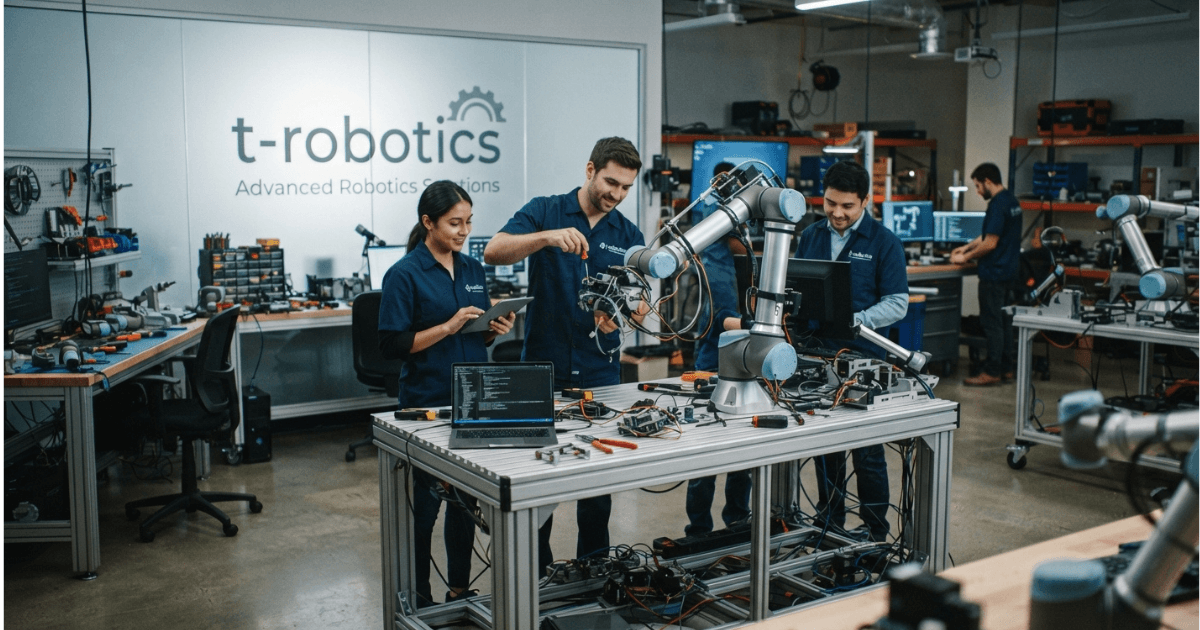
When people search for T-Robotics, they actually find two different companies sharing one name. One is a South Korean robotics company built on advanced robotic technologies for semiconductor manufacturing and industrial automation. The other is a young robotics software company, also called T-Robotics FPC, founded in 2024 and headquartered in San Francisco.
Both company profile pages, on DroidAge and Craft.co, describe businesses working across application software, enterprise software, and factory automation. This makes it an interesting name to research, since the two firms take very different paths toward the same broad goal: helping industrial robots operate and program faster through smart technologies.
What Is T-Robotics?
The older T-Robotics started around vacuum transfer robots, Founded in 2004, long before artificial intelligence algorithms became common. Its product areas grew into Vacuum Robots, Autonomous Mobile Robots, and Human Support Robots, built for semiconductor work and demanding manufacturing environments.
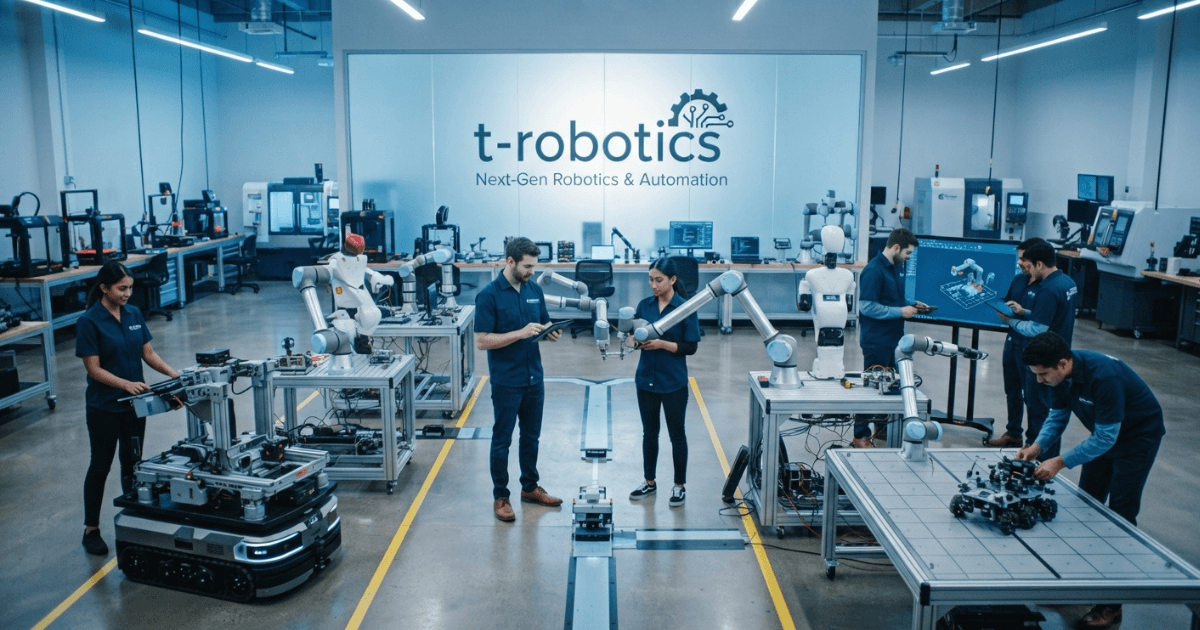
The newer T-Robotics is a different animal entirely. Its ActGPT platform supports industrial robot programming using natural language instead of traditional coding methods, making robotic automation more accessible for manufacturers. This version relies on integrated sensors, control systems, and AI software for material handling, assembly, and inspection.
Company Details
Craft.co and DroidAge both list a founded date of 2024, with headquarters at 301 King Street, Unit 706, California. This is a private, active company with an employee range of 1–10 people, and total funding of $5.4 million.
It also holds the title of winner of the ABB AI Startup Challenge, a solid signal of AI based robotics development from such a small team. Listed sectors span technology, artificial intelligence, automation, and robotics.
Software Focus in Industrial Robotics
AI sits at the center of this T-Robotics platform, wired into robotic systems that make decisions about tasks without constant hand holding. The platform is robot agnostic, meaning it isn’t locked to a single robot manufacturer, and works across different robotic systems.
This is where industrial robotics, Robot AI, and Factory automation meet, giving robotic platforms more flexible approaches to changing production requirements. The company blends automation and AI algorithms into one working software focused approach.
Applications
Factory floors rarely stay still for long, which is why AI based robot programming matters for shifting production tasks. It points to natural language interfaces for communicating tasks and configuring robotic operations without needing specialized technical knowledge.
Three concrete jobs stand out: Material Handling, where robots move materials to cut down repetitive manual work; Assembly, where controlled movements and programmed sequences handle coordinating operations; and Inspection, where AI technologies track production quality.
Together, this supports factory automation that stays adaptable and accessible.
Vacuum Robots
Vacuum robots do quiet, careful work most people never notice inside a chip factory. These built its core areas of expertise around transfer materials inside controlled vacuum environments, where cleanliness control and precise movement matter most.
The company builds both large vacuum robots for display manufacturing equipment and smaller systems for semiconductor applications, meeting strict demanding manufacturing requirements.
Autonomous Mobile Robots
Warehouses move a lot of stock, and that’s where Autonomous Mobile Robots earn their keep. These machines handle logistics automation, adjusting to changing requirements of modern logistics and automated material movement. Businesses use autonomous mobile robotics to automate transportation tasks inside warehouses and other industrial environments, described as a smart logistics solution.
Human Support and Rehabilitation Robots
Not every robot here is built for a factory floor. Rehabilitation robot activities focus on helping people regain functions needed for everyday activities, connecting hard engineering with digital healthcare. This includes wearable technologies built for assistance during walking and other daily movements.
Robotics Technology
A deep technology portfolio backs all of this work. Listed core technologies include multi axis robot mechanism design, vacuum technology, sealing, contamination control, motion control, and structural analysis the real engineering disciplines keeping precision machines reliable.
Robot Mechanism Design
Mechanism design gives the physical robot its shape. Work here covers serial drive concepts and parallel drive concepts for building multi axis mechanisms, along with vacuum introduction, lubrication, and cooling for demanding environments.
Vacuum and Clean Technology
Clean rooms don’t forgive sloppy engineering. Vacuum manufacturing demands tight control over sealing, particles, and outgassing, using magnetic sealing, bellows design, and low outgassing technology as core capabilities.
Motion and Control Technology
Smooth robot movement isn’t simple to achieve. Real effort goes into optimized acceleration and deceleration control, plus vibration reduction technology and stable control structures supporting manufacturing productivity.
Structural Engineering
Big robots need careful structural thinking behind them. Large industrial robots demand strong structures that manage deflection and vibration, using high-rigidity designs built for high loads and high temperature operating conditions.
Industrial Automation
Beyond single robots, this runs a wider push into automation. Its structure includes a full robot automation division covering collaborative robot automation, intelligent manufacturing, and EFEM systems across one organizational structure.
Global Operations
It doesn’t run from one building — it operates across Korea, China, and the United States. Headquarters sit in Osan, alongside a technology research center in Seongnam, a Chinese subsidiary in Shenzhen, and a U.S. office in Fremont. Global partners include Samsung Display, LG Display, BOE, CSOT, Tianma, and Sharp.
Why Robotics Technology Matters
Industrial robotics keeps growing in importance as factories demand more precision. Modern manufacturing increasingly needs consistency, cleanliness, and automation.
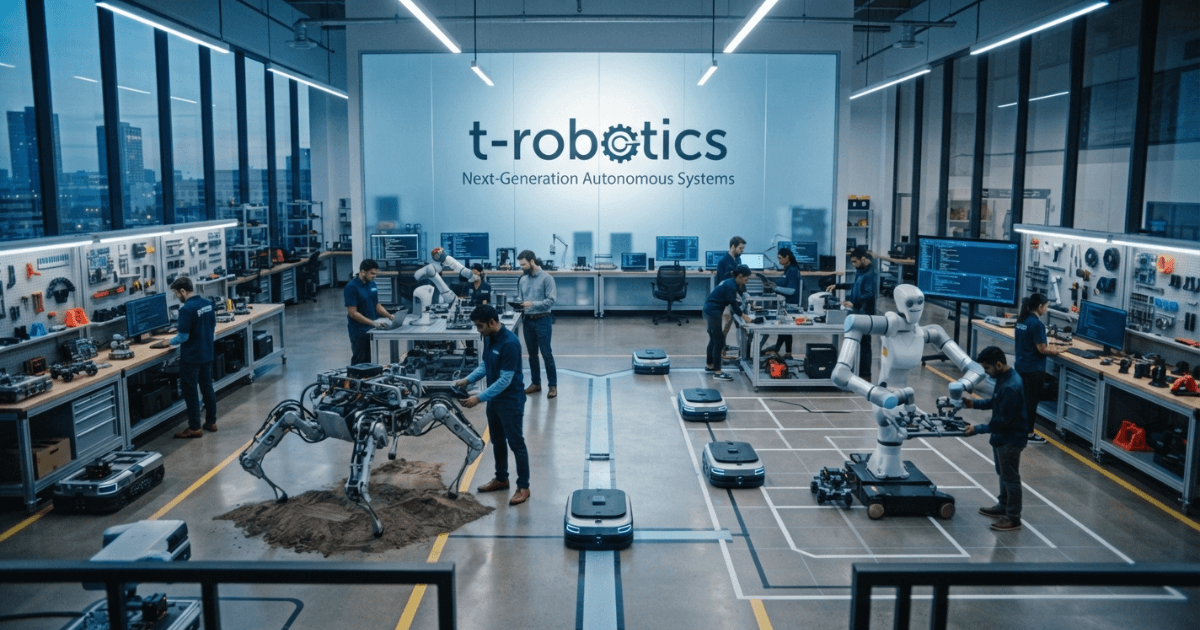
Especially inside semiconductor manufacturing under highly controlled conditions. T-Robotics answers this through specialized vacuum robotics while branching into logistics automation and human support robotics.
ActGPT Technology
ActGPT gets the most attention in the T-Robotics profile. Built on artificial intelligence, it enables natural language programming of industrial robots, letting users talk to robotic systems through language based instructions instead of conventional programming methods.
Vision, Haptics, and Language
This platform blends several senses into one system. It combines vision, haptics, and language to give robots different forms of information — vision for surroundings, haptics for physical interaction, and language for natural way communication.
Future of Natural Language Robot Programming
Natural language programming feels like an emerging approach rather than a finished product. Instead of every robotic task getting manually programmed, AI systems aim to turn human instructions into actions that robots can carry out.
Industrial Robotics Solutions
Programming an industrial robot the old way meant specialized knowledge and dedicated software. This focuses on the software side, blending sensor information, AI algorithms, and control technologies into one workflow supporting repeatability.
Integrated Sensors and Control Systems
Sensors quietly decide how well a robot performs. Integrated sensors work alongside AI algorithms and control systems, feeding information about a robot’s environment back so robotic systems control their movements correctly.
T-Robotics Leadership
Leadership tells you a lot about a company’s direction. Craft.co names Asad Tirmizi as CEO, Lars Tingelstad as CTO, and Alejandro Astudillo as VP of Software, reflecting strong executive leadership in robotics software.
T-Robotics Headquarters
The Craft profile places T Robotics headquarters at 301 King St, Unit 706, San Francisco, California. Craft currently lists just one location for this company profile.
T-Robotics and the Future of Automation
Manufacturers keep leaning into software first thinking, and this T-Robotics sits right inside that shift. Sensors, AI, and advanced control systems help robotic platforms handle complex industrial tasks as factories grow more sophisticated.
Conclusion
The older T-Robotics grew from a specialist vacuum transfer robotics company into a broader robotics and automation business, covering vacuum robots, autonomous mobile robots, and human support robots. The newer version, a San Francisco based firm, took a different primary focus entirely.
Its primary technology, ActGPT, enables natural language programming so industrial robots become easier to program, blending vision, haptics, and language. Both companies push toward smarter industrial robot programming from opposite directions.
FAQs
What is T-Robotics?
Depending on which company you mean, T-Robotics is either a South Korean robotics company building vacuum robots and autonomous mobile robots, or a San Francisco based robotics software company focused on AI powered industrial robot programming.
When was T-Robotics founded?
The older firm was established in 2004 around vacuum transfer robotics, while records show the newer T-Robotics was founded in 2024.
Where is T-Robotics headquartered?
The newer company is headquartered in San Francisco, California, United States.
What does T-Robotics develop?
It develops ActGPT, an AI software platform for natural language programming, along with integrated sensors, AI algorithms, and control systems for industrial robots.
What is T-Robotics vacuum robots used for?
They support material transfer applications inside controlled manufacturing environments, particularly semiconductor and flat panel display production facilities.