

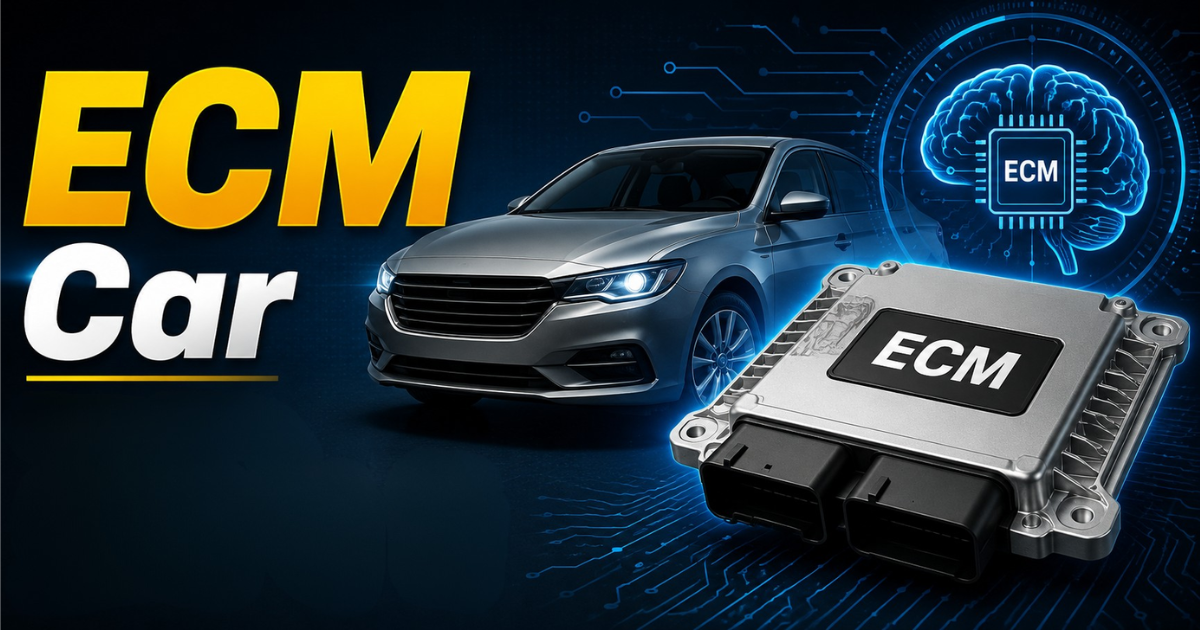
Anyone who owns an ECM car eventually learns that this small computer controls almost everything under the hood. It reads signals from sensors and makes constant adjustments so the car runs smoothly in any condition.
From daily commutes to long highway drives, a car depends on this unit to balance power, fuel use, and emissions. Technicians often check it first when diagnosing engine trouble in any ECM car.
How Does the ECM Work?
Inside every ECM, car sensors track coolant temperature, throttle position, and airflow, feeding that data back within milliseconds. Based on this data, the module fine-tunes fuel delivery and spark timing so the ECM car reacts quickly to every driving demand.
This constant feedback loop means an ECM car adapts instantly to hills, traffic, or towing loads. When something fails, the module stores a fault code that mechanics use to fix the issue quickly.
Components Controlled by the ECM
A well-tuned ECM car manages fuel injectors, spark timing, and air intake to keep combustion efficient. It also regulates the cooling fans and emission systems to meet environmental standards.
Safety features benefit from this system as well, as an car frequently coordinates with the ABS to keep the wheels from locking up during hard stops. It even manages gear shifts, cutting down on wear and improving comfort features like climate control.
ECM Across Different Vehicle Technologies
Whether it is a diesel, gasoline, or hybrid power, every ECM car relies on the same core logic to stay efficient. Even electric and hydrogen models depend on this technology for battery and thermal management.
Manufacturers trust the flexibility of a car because it adapts across engine types without losing reliability. This is part of why the system remains central to vehicle design today.
Why the ECM Is Important
Owning an ECM car means having a vehicle that actively monitors its own health and performance. It reduces emissions, improves fuel economy, and keeps the engine responding quickly to driver input.
Over time, it protects long-term reliability by catching problems before they grow serious. As technology advances, this system will keep shaping safer, cleaner driving for every ECM car on the road.
Diagnostic Functions of the ECM
When a warning light appears, it has usually logged a diagnostic trouble code worth checking right away. Technicians use an OBD-II scanner to read these codes and pinpoint the issue fast.
This diagnostic ability makes owning an ECM car far easier to maintain than older mechanical systems. Repairs become quicker since the module already points technicians toward the likely cause.
Conclusion
At its core, an ECM car relies on a microcontroller that processes sensor data and sends commands to the engine. Memory chips store both permanent software and real-time data for smooth operation.
Voltage regulators and capacitors protect these components from power fluctuations inside an ECM car. Together, they keep every signal accurate and every function running without interruption.
FAQs
ECM Car
What role does the ECM play inside a car?
The ECM acts as the brain of an ECM car, reading sensor data and adjusting fuel injection, ignition timing, and airflow in real time. This keeps the engine efficient, responsive, and properly balanced under changing driving conditions.
How does the ECM improve fuel efficiency?
It constantly monitors oxygen levels, throttle position, and engine load to fine-tune fuel delivery for each situation. This reduces waste and helps an ECM car maintain better mileage without sacrificing power.
What happens when the ECM detects a problem?
The ECM stores a Diagnostic Trouble Code (DTC) that technicians can read using an OBD-II scanner. This helps mechanics pinpoint the issue quickly, saving time and preventing further engine damage.
Does the ECM affect braking and safety systems?
Yes, the ECM often works with the Anti-lock Braking System to manage brake pressure and prevent wheel lock-up. It further assists protective systems such as airbags and seat belt Pretensioners, activating them the moment a collision occurs. Is the ECM used in electric and hybrid vehicles too?
Yes, an ECM car isn’t limited to gasoline or diesel engines hybrid, electric, and hydrogen vehicles rely on it too. In these vehicles, it manages battery performance, thermal control, and energy distribution.