

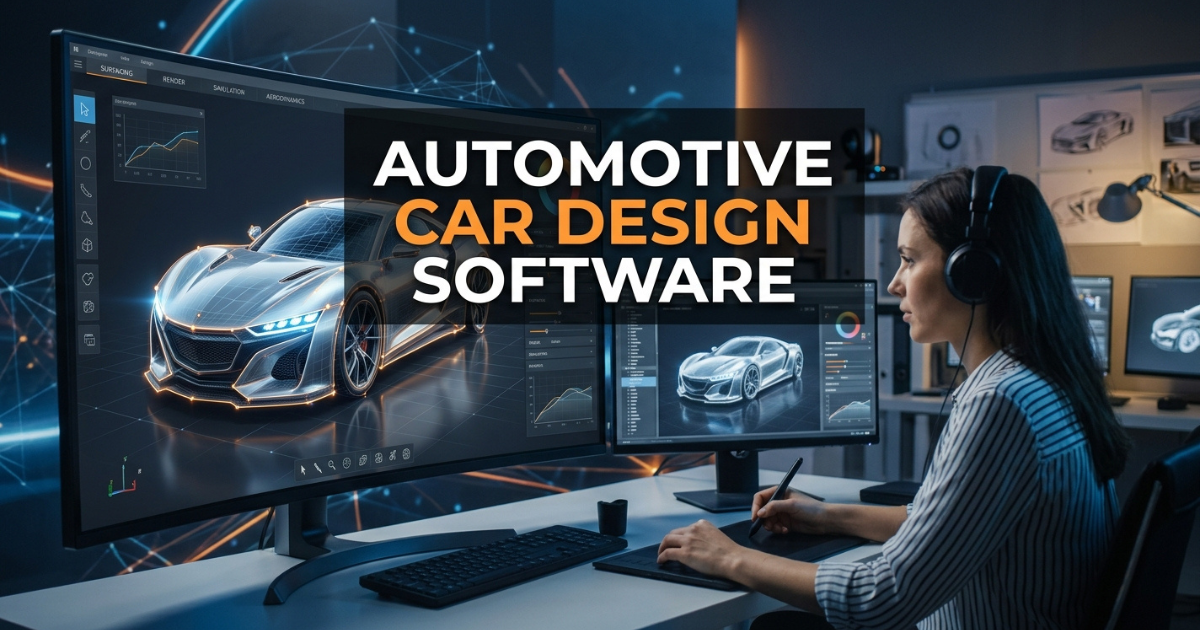
Automotive car design software has replaced the pencil and paper sketching that once defined the early stages of vehicle development, and it now carries a project from a rough concept all the way through engineering, simulation, and manufacturing prep. Designers still sketchy, but the tools around that sketch have changed everything about how fast a car can move from idea to production.
Why Automotive Car Design Software Matters
Modern vehicle programs juggle thousands of parts, tight weight targets, and shrinking development timelines. Automotive car design software addresses all three by combining modeling, simulation, and manufacturing planning in a single digital workflow.
Instead of building a physical prototype for every iteration, teams can test aerodynamics, structural performance, and manufacturability inside a virtual environment first — saving both time and cost while catching problems long before metal gets cut.
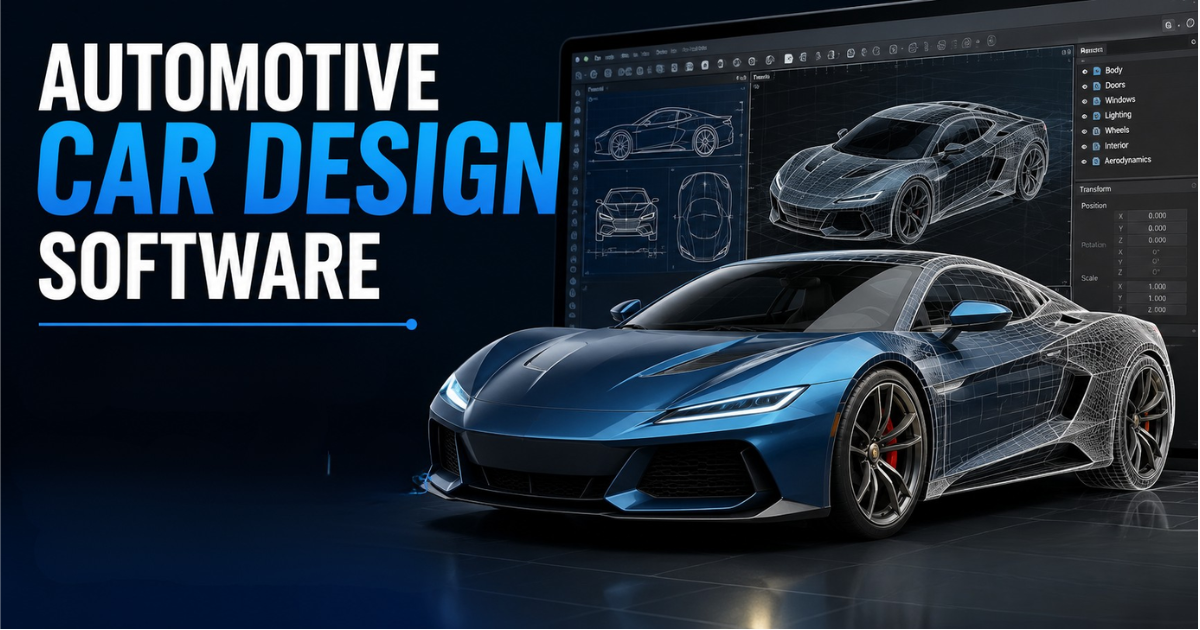
This shift also supports newer priorities in the industry: electric drive trains, autonomous vehicle systems, light weighting, and additive manufacturing all depend on software that can handle complex geometry and simulate real world performance early in the process.
Siemens NX
Siemens NX (formerly Uni graphics) is one of the most complete packages in automotive car design software, combining CAD, CAM, and CAE in one suite. It’s built for large, complex assemblies and supports generative design for lightweight components, along with strong tools for sheet metal design and simulation driven manufacturing prep.
A standout feature is its support for Design for Additive Manufacturing (DfAM), which automates supportstructure creation and optimizes build orientation, time, and material use.
NX also offers immersive VR design review through headset based walkthroughs, letting teams evaluate ergonomics and fit at full scale before committing to physical prototypes. Volkswagen Group, Ford, General Motors, and Tesla all use NX in various stages of vehicle development.
Licensing options include perpetual, subscription, and educational tiers, with regional pricing that varies between markets like the US and India. Siemens also offers a token based licensing model that lets team’s access add on modules covering everything from electrical systems to PCB design from a shared pool rather than buying separate permanent licenses for each.
CATIA
CATIA, from Dassault Systèmes, is best known for Class A surfacing the gold standard for exterior vehicle panels where curvature continuity really matters. It has a notably steep learning curve, but that investment pays off in power train design, chassis design, and digital mockup validation for complex assemblies.
Ferrari, Mercedes Benz, BMW, McLaren, and Toyota all rely on CATIA for vehicle programs where surfacing quality and aerodynamic performance are nonnegotiable. Pricing includes perpetual licenses with maintenance, term licenses, and subscription options billed quarterly or annually.
Solid Works
Also from Dassault Systèmes, Solid Works is a more approachable entry point into automotive car design software, particularly for smaller teams, startups, and suppliers. Its parametric modeling feels more intuitive than CATIA’s, making it well suited to component design and aftermarket parts rather than full vehicle programs.
It handles mechanical components, moderate complexity assemblies, motion analysis, and sheet metal design well. While large OEMs typically use heavier tools, SolidWorks dominates the supplier ecosystem Koenig egg and various motorsport teams have used it for rapid part development. Pricing runs through term or perpetual licenses.
Creo Parametric
PTC’s Creo Parametric (formerly Pro/ENGINEER) remains popular among tier one suppliers for its precise, relationship driven parametric modeling — ideal for power train and chassis components where dimensional accuracy is critical. It includes manufacturing process simulation and advanced surfacing tools, and companies like Volkswagen, Toyota, and BMW use it for specific power train development tasks. It’s typically sold as a flat subscription, with regional package variations.
Autodesk Inventor
Autodesk Inventor is a strong option for automotive component and system design, particularly on large assemblies where level of detail (LOD) representations help manage performance. It offers solid sheet metal and frame design tools, useful for chassis work, and integrates well with manufacturing workflows.
Specialty vehicle builders including electric vehicle manufacturers for mining and industrial applications often choose Inventor for its balance of flexibility and simulation support. Pricing includes monthly, annual, and three year subscriptions, plus flexible token options.
Rhino
Rhino, from Robert McNeel & Associates, takes a NURBS based approach that gives designers freedom to build organic, complex surfaces without being locked into parametric history. That makes it a favorite for early stage, unconventional concept work. Its Grasshopper add on brings visual programming into generative design, and it interoperates well with other CAD systems at a comparatively low cost.
Design studios like Pin in farina and BMW Design works use Rhino regularly. Licensing includes commercial, educational, and upgrade tiers.
Autodesk Alias
Alias occupies a unique spot as the bridge between conceptual sketching and engineering handoff. Built around NURBS and Bézier surfaces, it’s the longstanding industry standard for automotive styling, balancing aesthetic appeal with aerodynamic performance.
Tesla, Aston Martin, Lucid Motors, and Jaguar Land Rover all lean on Alias for exterior and interior surface development. It’s sold through monthly, annual, and threeyear subscriptions, along with flexible tokens.
Fusion 360
Autodesk Fusion 360 represents the cloud connected generation of automotive car design software, combining organic modeling, parametric design, generative design, and manufacturing prep in one affordable package.
It suits smaller manufacturers, aftermarket suppliers, and racing teams especially well — Czinger Vehicles has used it for 3Dprinted hyper car components. Its generative design tools are particularly good at producing lighter parts without sacrificing strength. Pricing runs on annual or three year subscriptions.
Emerging and Specialized Tools
Blender
It is started as animation software but has earned a real place in early automotive concept work thanks to its strong polygon modeling and sculpting tools and it’s free. Tata Motors has used it for early stage model design, and it’s popular among younger designers experimenting outside traditional paid platforms.
Key Shot
It is from Luxion, focuses purely on rendering and visualization, turning CAD models into photorealistic images for design review and marketing. It also supports full color 3D printing export formats. Audi, Ford, Ferrari, and Nissan use it for rapid concept visualization.
3ds Max
It is a friendlier entry point for beginners learning surface modeling, and it supports VR based immersive visualization for design reviews.
On Shape
It is built by former Solid Works engineers, is a fully cloud native CAD platform requiring no local installation. Its real time collaboration and version control make it attractive to distributed and remote teams the open source Perrin LMP1 racing car was built entirely on this platform.
How Studios Combine These Tools
No single platform covers the entire vehicle development process. A typical studio workflow moves through concept development in Blender, Rhino, or Alias, then Class A surface development in Alias or CATIA, engineering integration in CATIA, NX, or Creo, simulation and validation through CAE tools, and finally visualization and review in Key Shot. Keeping data consistent across each handoff is what separates efficient studios from ones that lose time to rework.
Where the Industry Is Headed
A few trends are reshaping automotive car design software going into 2025 and beyond. A assisted design including text to CAD and scan to CAD tools from startups like Back flip AI and Zoo.dev is starting to reshape early stage workflows.
Real time simulation is closing the gap between design and analysis, cutting out the slow design test redesign loop. Extended reality (VR/AR) is becoming a standard part of design review at companies like BMW and Audi, letting teams evaluate a vehicle before any physical prototype exists. And additive manufacturing is moving beyond prototyping into actual production parts, particularly for brackets, cooling components, and low volume or heritage parts.
Final Thoughts
Choosing the right automotive car design software depends heavily on where a designer sits in the development process. Rhino and Blender suit early conceptual and organic modeling work.
CATIA and Siemens NX dominate detailed surfacing and full engineering; Key Shot handles final visualization and communication. For smaller teams or limited budgets, Fusion 360 offers the best balance of modeling, simulation, and manufacturing prep in one accessible package.
There’s no single tool that does everything well real efficiency comes from understanding how these platforms fit together and building a workflow that uses each one for what it does best.
FAQs
What does automotive CAD software actually do?
It lets designers sketch, model, simulate, and refine a vehicle digitally before any physical part is made covering everything from rough concepts to Class A surfacing and engineering validation.
Which tool should a beginner start with?
Most beginners start with sketching apps like Sketch Book Pro or Photoshop, then move into Fusion 360 or Solid Works before tackling steeper learning curve tools like CATIA or Siemens NX.
Do I need expensive software to learn car design?
No, Blender is free and offers real hand son modeling and rendering practice, and most commercial platforms offer discounted student or educational licenses.
How does 3D printing fit into the process?
Once a design is validated in CAD, it can be exported directly for 3D printing used for rapid prototyping, replacement parts, or small production runs, with tools like Key Shot and Siemens NX supporting that handoff.
Can cloud based platforms replace desktop CAD tools?
Cloud platforms like On Shape already handle real automotive projects, especially for smaller or distributed teams, and many studios now blend cloud and desktop tools depending on project size.