

I have watched factory floors change fast, and this machine vision systems overview 2026 captures exactly that shift. Cameras, artificial intelligence, and processing hardware now work together in ways that felt rare a few years back. This machine vision systems overview 2026 walks through where vision systems stand today, told plainly, not like a textbook.
What Is a Machine/Manufacturing Vision System?
A manufacturing vision system pairs cameras, lighting, optics, image sensors, and specialized software so a machine can look at a part and understand it.
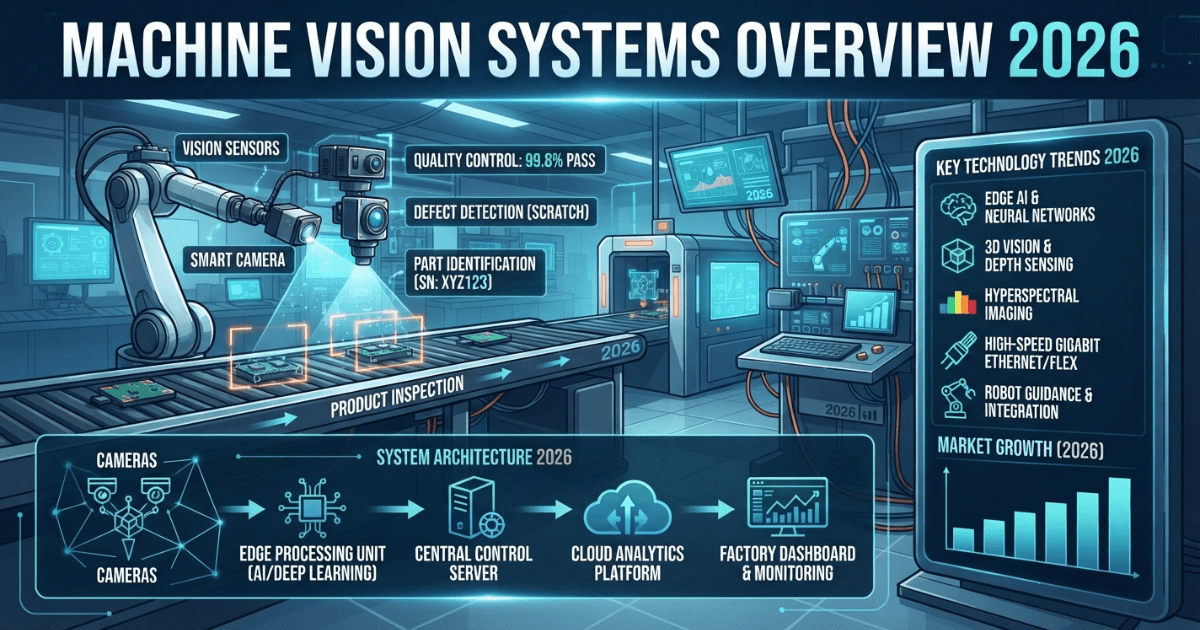
These setups capture and analyze images to measure dimensions, verify components, read codes, check labels, recognize objects, track inventory, monitor equipment, and guide robots.
Machine Vision for Logistics
Speed and accuracy in logistics operations now depend heavily on vision technologies built around identification, tracking, and object detection. AI cameras, 3D vision, and active focus technologies combine to sharpen detail about packages, feeding automated logistics systems.
Inside warehouses, AI-powered vision systems watch product movement, handle inventory monitoring, and cut down manual monitoring across the operation.
The Future of Machine Vision
Vision technology keeps advancing, and any honest machine vision systems overview 2026 should note that learning-based inspection is getting simpler every quarter.
Factory integration is deepening, letting robots, PLCs, and manufacturing software speak the same language, while 3D inspection capabilities open new ways to measure shape and volume.
Predictive quality control built from vision data will soon spot patterns that hint at quality problems before they happen, pushing toward predictive quality management.
Trends shown at VISION 2026 point toward systems blending 2D imaging, event-based sensing, and edge processing into one package for changing environments, building the base for smart factories and autonomous machines.
Major Vision System Trends in 2026
Industrial cameras keep climbing toward higher resolutions while staying affordable, and a camera above 20 megapixels is now realistic for everyday manufacturing applications.
That detail helps spot smaller features and fine defects, covering larger areas without stacking on several cameras. Low-code interfaces now let manufacturing teams build inspection applications without heavy programming expertise, trimming installation time and integration time.
Types of Vision Systems for Manufacturers
Picking the right vision architectures starts with actual inspection requirements, not the shiniest brochure, a lesson every machine vision systems overview 2026 should repeat. Smart cameras pack a camera, processor, and software into one compact device, ideal for simple inspection tasks in limited space.
PC-based vision systems pair industrial cameras with a computer for stronger processing power, while integrated vision platforms ease deployment, and vision sensors cover straightforward applications.
Common Manufacturing Applications
Surface defect inspection catches scratches, dents, and corrosion, while dimensional measurement checks product dimensions without touching the part. Barcode reading covers QR codes and serial numbers tied to product identification and traceability, and robot guidance passes position information to robotic equipment.
Label inspection, packaging inspection, and weld inspection round things out, with machine vision spotting visible issues on the shop floor.
Best Practices for Implementing Vision Systems
Every successful rollout begins with clear objectives tied to a particular defect or a plan to cut manual inspection requirements. Lighting priority matters next, since even a great high-resolution camera delivers unreliable results if illumination gets ignored, and teams should always test actual production parts using real products and genuine defective parts.
Involve different teams across operations, quality, and maintenance, and start with one application before you expand vision inspection further.
What Is VISION 2026?
VISION 2026 stands out as a genuine international trade fair built around machine vision and image processing in Messe Stuttgart from October 6 to 8, 2026. IDS frame its presentation around Trends, Innovations, and Future, aiming to make advanced vision technologies easier to integrate into real-world systems.
Event-Based Vision
Event-based vision surprised me the first time I saw it demoed, since it skips the old habit of grabbing complete images at fixed intervals. Event-based cameras react only to changes in a scene, suiting dynamic environments where objects move rapidly, built with Prophase for drones and automated guided vehicles.
The resulting event-based imaging supports object tracking, navigation, and high-speed motion analysis wherever frame-based cameras hit real limitations.
AI Cameras and Embedded Vision
Artificial intelligence keeps creeping closer to the lens, and IDS has expanded its uEye Live monitoring camera family with AI-enabled models running processing right at the edge.
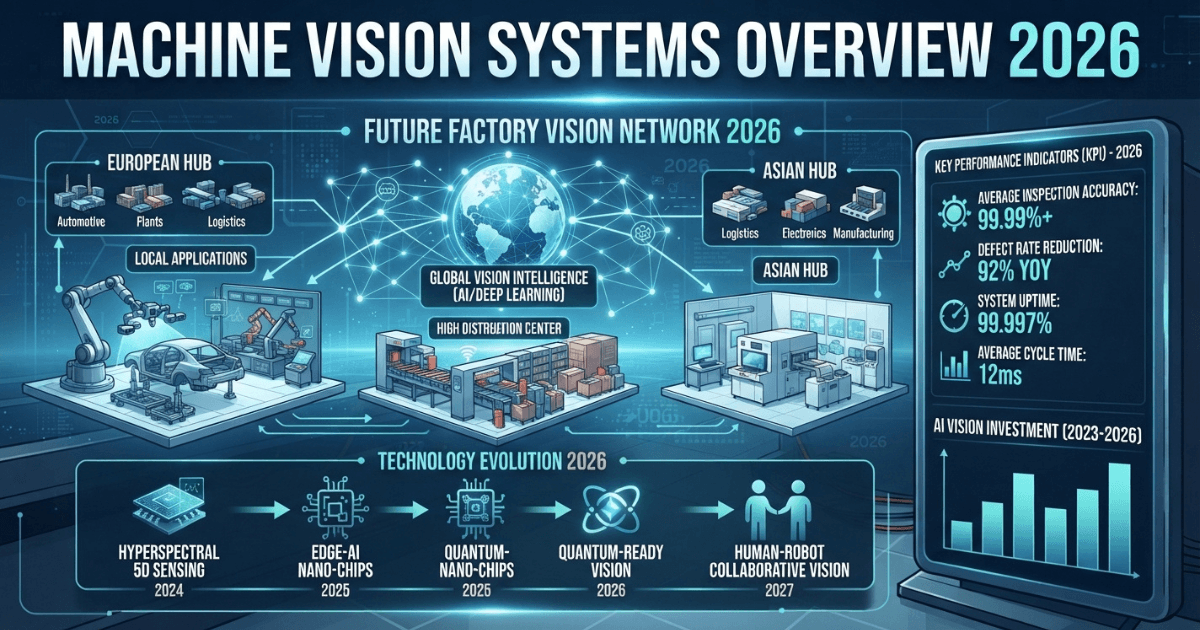
This edge processing pays off with quick responses and compact system designs. The resulting AI vision solutions cover object detection, orientation, and code reading with far less hardware than before.
GMSL Multi-Camera Vision Systems
The GMSL multi-camera vision system from IDS, shown through its Discovery Kit, demonstrates how multiple cameras feed images that get processed inside a single embedded system. System-on-chip technology lets image data get handled internally, and the result travels out over one GMSL cable. That setup cuts latency while freeing up host-computer processing resources, a real win for mobile applications.
Cameras with Active Focus Control
Camera focus gets tricky once objects sit at different distances, and IDS answers with its Active Focus innovation project. Focus control and feedback live directly inside the camera, letting software adjust focus in real time. Logistics, autonomous systems, and retail stand to benefit most as integrated focus control helps vision systems adapt to changing conditions.
NDVI Camera for Agriculture
Machine vision is stretching well past traditional industrial inspection, and the IDS NDVI camera proves it by turning a lens toward vegetation analysis. Built around the Normalized Difference Vegetation Index, this pairs with conventional color imaging to make plant conditions easier to read. The resulting NDVI information supports agricultural planning and resource management for growers.
New uEye Vision Camera Platform
Looking ahead, IDS is rolling out the uEye Vision camera platform as a fresh technological foundation for future 2D industrial camera series. It arrives with a redesigned housing and updated electronics architecture built to last. The platform aims squarely at performance, reliability, and real long-term scalability.
VISION MAKEATHON 2026
The VISION MAKEATHON puts interdisciplinary teams to work on genuine image-processing challenges, forcing practical prototypes out of raw ideas fast. Themes stretch from sustainable processes to smart agricultural solutions. IDS joins in with its own challenge, supplying cameras and hands-on technical expertise.
Industrial VISION Days
Industrial VISION Days stacks presentations, panel discussions, and sharp technical insights from across the machine vision industry. IDS runs its own session built around Camera-based process monitoring. The talk covers continuous monitoring, event logging, and AI-supported analysis powered by trained convolution neural networks.
How Machine Vision Is Changing Manufacturing
Manufacturers no longer save machine vision for the end of a line, and that shift changes the whole production process. High-resolution cameras paired with AI now catch small defects and watch production activities in real time, helping teams cut waste and unexpected downtime. Distribution centers now lean on automated vision systems to track inventory and flag misplaced items.
Key Applications of Machine Vision in 2026
Predictive maintenance is quietly replacing reactive maintenance, since vision systems watch machinery for visual changes tied to wear and damage. Product inspection and testing stays central, with deep-learning models spotting defects that human inspectors struggle to catch consistently.
Workplace safety monitoring rounds out the picture as real-time visual analysis flags hazardous conditions, sending automated alerts so supervisors react faster.
Advanced Vision Sensors
Production environments keep speeding up, and that pressure is exactly why high-speed imaging technologies matter for any serious machine vision systems overview 2026. Advanced vision sensors can capture and process visual information with almost no minimal delay. High-speed imaging earns its keep where objects move rapidly or production lines run at real high throughput.
Hyper spectral Machine Vision
Conventional cameras mostly stay locked to the visible spectrum, but hyperspectral imaging reaches past that limit to surface information a standard camera would miss. This lets systems analyze characteristics tied to material composition and identify differences invisible in ordinary images. Hyperspectral vision becomes genuinely useful for quality control anywhere material identification matters.
Synthetic Data for AI Training
AI vision systems need solid training data, yet gathering enough real-world images gets hard when a system must learn rare defects. Synthetic data solves part of that by generating simulated visual examples purpose-built for AI training. Manufacturers lean on virtual scenarios to expose models to uncommon situations without burning time on real datasets.
Hybrid Vision Sensors
Blending conventional frame-based imaging with event-based sensing is a clever move, since traditional cameras capture complete frames while event-based sensors watch only for changes in light. That lets a system respond quickly, trimming unnecessary visual data while handling fast motion.
Hybrid vision sensor technology fuses both approaches, keeping detailed visual information available alongside rapid detection of movement and changes.
Challenges to Consider
Machine vision still needs careful implementation to pay off, and manufacturers should never skip choosing the right cameras and sensors for the application. Lighting, object movement, and environmental conditions all shape final system performance.
Integration rounds out the list, since a system often has to talk cleanly with PLCs, robots, and factory equipment already running on the floor.
Conclusion
Vision systems have earned their place as a core tool for manufacturers chasing consistent inspection, and this machine vision systems overview 2026 shows that trust only growing.
Picking the right setup starts with honest inspection requirements, production speed, and long-term costs, backed by quality, engineering, and IT teams working from one plan.
Real intelligent automation now covers predictive maintenance, safety monitoring, and assembly inspection, giving automation a stronger foundation for data-driven operations.
FAQs
What does a machine vision systems overview 2026 actually cover?
A machine vision systems overview 2026 covers cameras, AI, edge processing, robotics, and inspection applications working together across manufacturing, logistics, and agriculture. It explains how manufacturers choose between smart cameras, PC-based vision systems, and integrated vision platforms.
Why does edge processing matter in a machine vision systems overview 2026?
Edge processing lets image analysis happen on the production line instead of a remote cloud system, cutting latency and speeding up pass-or-fail decisions. Any current machine vision systems overview 2026 treats this as a core trend shaping industrial automation.
How does AI change what a machine vision systems overview 2026 includes?
Artificial intelligence adds learning-based systems that handle complex visual variations traditional rules cannot catch. A modern machine vision systems overview 2026 always pairs AI-based inspection with traditional algorithms for balanced results.
What industries benefit most from a machine vision systems overview 2026?
Manufacturing, logistics, robotics, and agriculture all gain from developments highlighted in a typical machine vision systems overview 2026, including 3D vision, predictive maintenance, and warehouse management tools.
Where can I see live demonstrations related to a machine vision systems overview 2026?
Events like VISION 2026 in Messe Stuttgart offer hands-on demos of event-based cameras, 3D vision, and AI-enabled cameras, giving a real-world companion to any written machine vision systems overview 2026.