

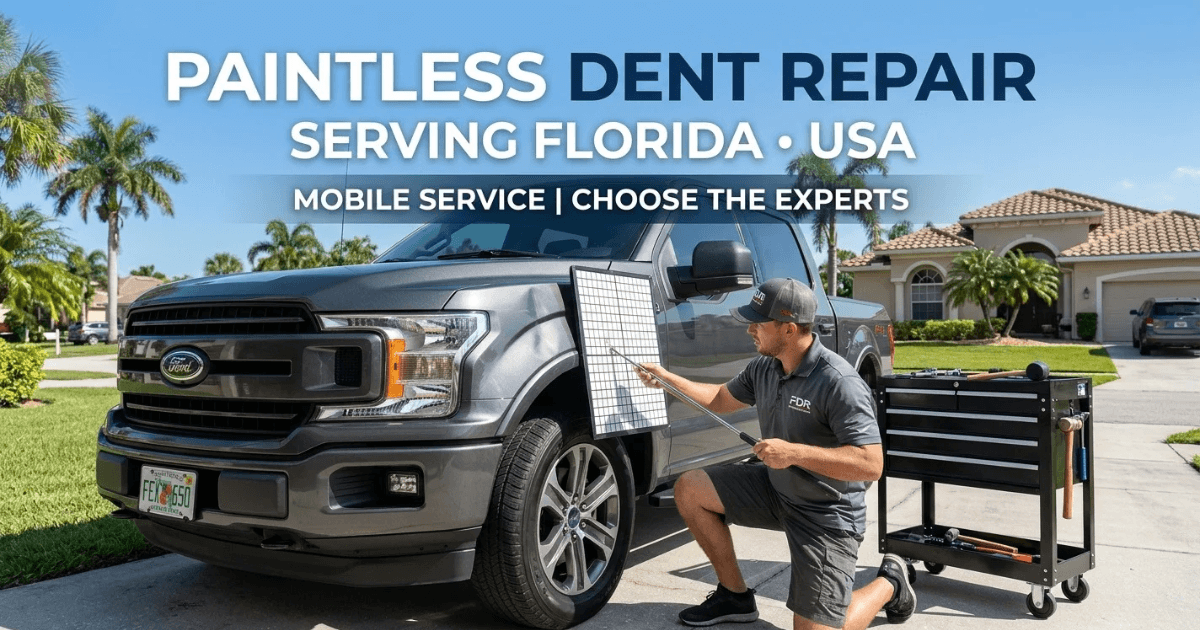
Paintless dent repair in Florida usually costs far less than a body shop, but the exact price depends on the dent in front of the technician. One Florida mobile shop publishes a starting price of $160 for dents one inch or smaller, and larger or harder dents cost more. This guide explains what drives the price so you can judge any quote with confidence.
Most people search for a single number. The honest answer is a range, because two dents that look the same can take very different amounts of time. Below, you will learn what changes the price, how hail claims work, and how to get a firm quote without leaving your driveway.
Inside PDR: How Technicians Pop Out Dents without Repainting
Paintless dent repair, often called PDR, is a way to fix dents by pushing the metal back into shape from behind the panel. A PDR technician uses long rods and specialty tools, so there is no sanding, filler or new paint. Your factory paint stays exactly as it left the plant.
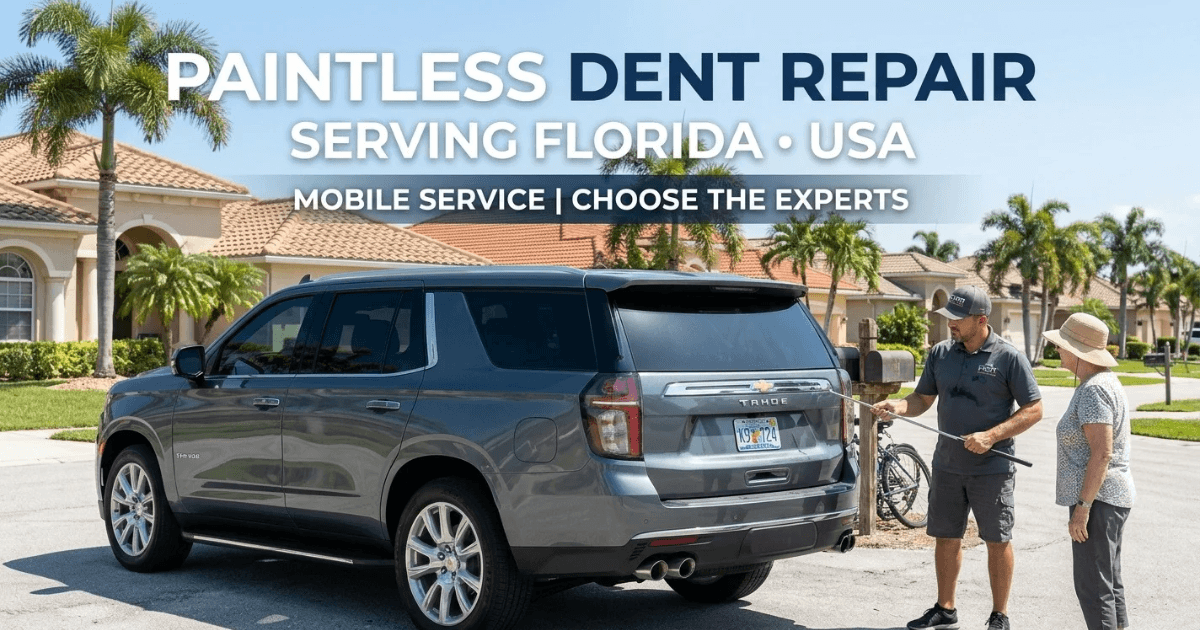
A technician reaches the back of the dent through openings in the door, a removed light or an inner liner. They then massage the metal in small, controlled pushes until the surface reflects light evenly again.
Because nothing is repainted, PDR leaves no color mismatch to explain later. That matters if you plan to sell, trade in or return a leased car. It also explains why paintless dent removal is often faster than traditional bodywork.
What You’ll Pay for Paintless Dent Removal in Florida?
A small, simple ding in Florida often starts around $160 at mobile PDR shops, based on one Tampa-area company’s published starting price. Larger, deeper or hard-to-reach dents cost more, and hail damage is priced differently. The only way to get your real number is a free estimate based on photos.
Most Florida PDR shops do not publish a full price list. They prefer to see the dent first, because a flat rate would often be wrong once they inspect the car. Expect a price range from photos and a firm price once the technician confirms the damage.
National price guides online often list small single dents somewhere between about $75 and $250. Treat that as a rough estimate, not a Florida quote, because shops set their own rates. Your result can land above or below that range depending on the factors in the next section.
What does a small door ding cost to fix?
In Florida, expect a starting price near $160 for a dent one inch or less, based on published shop pricing. Many of these repairs take under an hour.
Parking-lot dings are classic PDR jobs because they are usually shallow and sit on flat parts of the door. The technician can often reach them through the door’s inner openings. If you have several on one side of the car, ask for a combined price.
How much do multiple dents cost?
Several dents usually cost less per dent than one dent alone. Ask your technician to price all your dents together so you see the total before work starts.
The savings come from setup time. Once a technician has removed a trim piece or set up lights on one panel, the next dent nearby takes less effort. That is why bundling dents into one appointment is one of the easiest ways to lower your bill.
Why Do Dent Repair Quotes Differ So Much?
Six things decide most PDR prices: the dent’s size and depth, the dent location on the panel, how easy it is to reach, the number of dents, the paint condition, and the panel’s metal. Your location matters less, since many Florida shops are fully mobile.
Think of it as time and risk. Anything that makes the technician slow down or remove parts raises the price. Anything that lets them work quickly and safely keeps it low.
How do dent size and depth affect cost?
Dent size sets the starting point, but dent depth often matters more. A shallow dent the size of a coin can be quick, while a sharp dent of the same width stretches the metal and needs slow, careful work. Deep, sharp damage costs more.
A hand-sized dent takes far longer than a dime-sized dent, even on the same door. Some shops ask you to measure the dent with a tape at its longest stretch before quoting. If you sit between two sizes, choose the larger one so the quote holds up on site.
Why does the dent’s location matter?
A dent on a body line, near a brace, or at the edge of a panel sits on stiffer metal, which takes more time and skill. That extra time shows up in the price.
Body lines are the sharp creases designed into a car’s shape. Restoring that crisp line takes careful work, so a bodyline crease often costs more than a round dent of the same size. Roof dents can also cost more because access usually means lowering the headliner.
How does access behind the panel change the cost?
If a technician must remove a trim panel, tail light or inner liner to reach the dent, the job takes longer and costs more. Easy access through existing openings keeps the price low.
Doors and hoods usually offer good access. A rear quarter panel or a dent near a pillar may need parts removed first. Ask your technician whether removal is needed, since that can explain a higher quote.
Does aluminum cost more than steel?
Yes, an aluminum panel usually costs more to repair than a steel panel. Aluminum is stiffer, holds its shape differently, and gives less warning before it cracks, so technicians work slower. Many newer trucks and luxury cars use aluminum hoods or body panels.
You can often check your owner’s manual or ask the dealer which panels are aluminum. Some quote forms let you choose steel, aluminum or “not sure,” and the technician confirms on site. Knowing this upfront helps your quote stay accurate.
What if the paint is cracked or chipped?
Paintless repair needs intact paint. In some cases, a technician removes the dent first and a painter handles the finish.
An honest technician will tell you whether your car is a good PDR candidate. That answer can save you a wasted appointment.
Is paintless dent repair cheaper than a body shop?
For most small and medium dents, yes. A traditional body shop charges for sanding, filler, primer, paint, blending into nearby panels and labor, so the bill grows quickly. PDR skips those steps, which is why its price is usually a fraction of body shop pricing for the same dent.
Here is a simple side-by-side view of what each repair includes.
| What you compare | Paintless dent repair | Traditional body shop |
| Paint | Original paint untouched | Sanded, filled and repainted |
| Typical time | 30 minutes to a few hours | Often several days |
| Where it happens | Your home or office (mobile) | You drop the car off |
| Vehicle history | Nothing new to report | Repairs may be reported |
| Best for | Dings, dents, creases, hail with intact paint | Cracked paint, torn metal, major collision |
The bigger win is often long term. A repainted panel can lower resale value and may show up on a vehicle history report such as Carfax if the work goes through insurance. PDR keeps the original factory finish, which also helps with antique and luxury cars.
What Does Hail Damage Repair Cost After Insurance?
With comprehensive coverage, hail damage repair is normally a covered claim, so your out-of-pocket cost is usually your deductible. Without insurance, hail repair is priced by panel and dent count, and it can cost much more than a single ding. Check your policy before booking.
Florida’s summer thunderstorms can bring hail storms, and hail tends to leave many small dents across the hood, roof and trunk. Because the dents are shallow and the paint is often fine, PDR is the common repair method. It also keeps the claim smaller and faster than repainting several panels.
How do insurers price hail damage?
Shops call this matrix pricing. A roof with dozens of small dents is quoted as a group, not as dozens of separate single-dent prices.
Many PDR shops can work straight from your insurance estimate and speak with the adjuster about extra damage. Ask before you book whether the shop handles that call.
Should you file a claim or pay out of pocket?
Compare the repair quote to your deductible. If one or two small dents cost less than your deductible, paying yourself usually makes more sense. If hail hit several panels, an insurance claim may save you money, but check your policy and talk with your insurer first.
Get a PDR quote before you call your insurer, so you know the real cost. Then weigh it against your deductible and any effect a claim might have on your rates. Your insurer or agent can explain how your specific policy works.
Does mobile dent repair cost more in Florida?
Usually not. Many Florida mobile dent repair companies charge no travel fee inside their service area. They come to your home or office, fix the dent on site, and the price stays the same as it would at a shop. Always confirm the service area before booking.
Florida shops tend to serve set regions. For example, one company covers Tampa up to Ocala and the Nature Coast, while others focus on Pensacola or Destin and 30A. If you live outside a listed area, ask whether a travel fee applies.
The convenience is real. You skip the shop drop-off, and many dings are fixed in a single visit while you work. That saved time is part of the value, even when two quotes look similar.
How do you get an accurate photo estimate?
Send three or four clear photos: one of the whole panel, one close-up from a slight angle, one straight on, and one at 45 degrees. Add your car’s year, make and model. Good photos let the technician give a tight range instead of a vague guess.
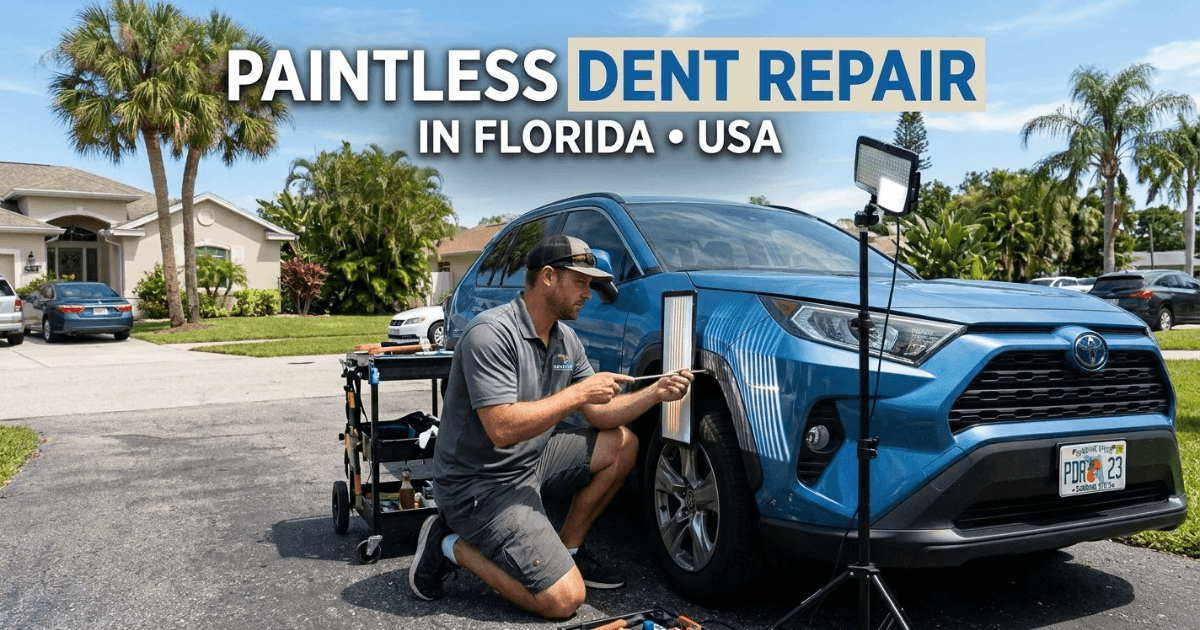
Shoot in soft daylight, since bright sun hides shallow dents and creases. A low angle shows the dent’s shape and depth more clearly. If a shop asks for a short video, walk slowly around the dent from about six feet away, then zoom in.
Most shops answer a free photo estimate within the same business day. The final price is normally confirmed on site before any work starts. A reputable shop will not charge you until you agree.
What are smart buyer tips for paintless dent repair?
Get two or three photo quotes, bundle all dents into one visit, and ask about access work. Check that the shop is licensed and insured, look at before and after photos, and read recent Google reviews. Never pay before you see the finished repair.
Here are practical steps that protect your money:
- Measure first: a tape measure on the dent helps you compare quotes fairly.
- Ask what is included: confirm whether trim removal and light removal are part of the price.
- Ask about aluminum: find out if your panel is aluminum before you accept a quote.
- Do not try a DIY fix first: a previous repair attempt with suction cups or glue kits can stretch the metal and raise the price.
- Time it right: fix a fresh ding soon, especially before a lease turn-in inspection or a trade-in appraisal.
Also, look for a technician who explains limits honestly. If a shop promises to fix a dent with cracked paint using PDR alone, be careful. The best technicians say no when PDR is the wrong tool.
Is paintless dent repair worth it?
Yes, for most dents with intact paint. You keep the factory finish, avoid a long shop visit, and usually pay less than a body shop. PDR is especially worth it before selling, trading in or returning a lease, when a clean panel protects your car’s value.
It is less useful when the paint is broken or the metal is torn. In those cases, a body shop is the right choice, and a good PDR technician will tell you so. Weigh the cost of paintless dent repair against the value you protect, not only against the price of doing nothing.
A small dent can also get worse over time. Rust can form if paint later chips around the damage, and that turns a simple fix into bodywork. Fixing it early usually keeps the cost of paintless dent repair at its lowest.
FAQs
Is Paintless Dent Repair Worth the Cost in Florida?
Small dents one inch or smaller often start around $160 at Florida mobile PDR shops, based on published pricing. Larger, deeper or hard-to-reach dents cost more. The cost of paintless dent repair is best confirmed with a free photo estimate, followed by a firm price on site.
How long does paintless dent repair take?
Most single dents take from about 30 minutes to a few hours. Large dents, creases or many hail dents can take six hours or more. Many mobile technicians finish a typical door ding in one visit at your home or office.
Does insurance cover paintless dent repair?
Insurance often covers hail damage under comprehensive coverage, and you pay your deductible. A small door ding usually costs less than a typical deductible, so many owners pay for it themselves. Always check your own policy before filing a claim.
Can PDR fix creases?
Yes, many creases can be fixed with PDR when the paint is not cracked. A sharp crease on a body line takes more time than a round dent, so it usually costs more. Send photos so the technician can judge depth and paint condition.
Will paintless dent repair show on Carfax?
PDR does not involve repainting, so there is no paintwork to report. A repair paid through an insurance claim may still be recorded by the insurer. Paying out of pocket for PDR usually leaves nothing new on a vehicle history report.