

Three months into owning my own car, I finally understood why so many people choosing hybrid cars in India were switching away from a fully electric vehicle. The constant queue at the petrol pump, paired with range fears and the shortage of fast chargers, made a fuel-efficient, city-friendly option feel far more practical.
Climbing fuel prices, endless traffic jams, and mounting environmental concerns are quietly nudging households toward hybrid cars in India as a reliable, forward-looking car. What sold me personally was the balance a good hybrid strikes.
A well-built hybrid only touches gas when it’s genuinely needed, handling daily commutes with strong real-world mileage. It still keeps decent performance intact without sacrificing comfort, which is rare in this price range.
Between strong hybrid cars that never ask for a charge and plug-in hybrid cars that draw electricity overnight, drivers now have smart choices. That trade-off between operating cost and miles per gallon is really where this whole EV future conversation begins.
Why Choose Hybrid Cars in India
I didn’t believe the fuel efficiency numbers until I tracked my own mileage for a full month. Hitting 20-28 km per litre is almost double what most conventional petrol cars manage on the same roads.
Across 1000 km/month, that difference quietly becomes real savings for anyone driving hybrid cars in India. My own monthly fuel spend dropped by nearly ₹2,000 to ₹3,000 within weeks of switching.
That stacks up to somewhere between ₹24,000 and ₹36,000 saved over a full year of ownership. The environmental side surprised me too, honestly more than the fuel bill did.
Running on electric motor power through heavy city traffic and slow running traffic cuts down air pollution noticeably. Electric mode replaces constant fuel burning and reduces pollutants compared to older gasoline-powered cars.
Between lower fuel bills, state-level financial benefits, and simple kilometre-by-kilometre investment logic, the case is clear. It’s easy to see why hybrids have become such a viable choice for Indians right now.
What is a Hybrid Car?
At its core, a hybrid car simply pairs two sources of energy — a petrol engine and an electric motor. It shifts between them automatically depending on driving conditions, without any input from the driver.
Crawl through congested areas and the electric motor quietly takes charge, saving fuel and trimming carbon emissions. Push down to accelerate and the petrol engine steps back in, delivering extra power the instant it’s needed.
Cheapest Hybrid Cars in India (2026)
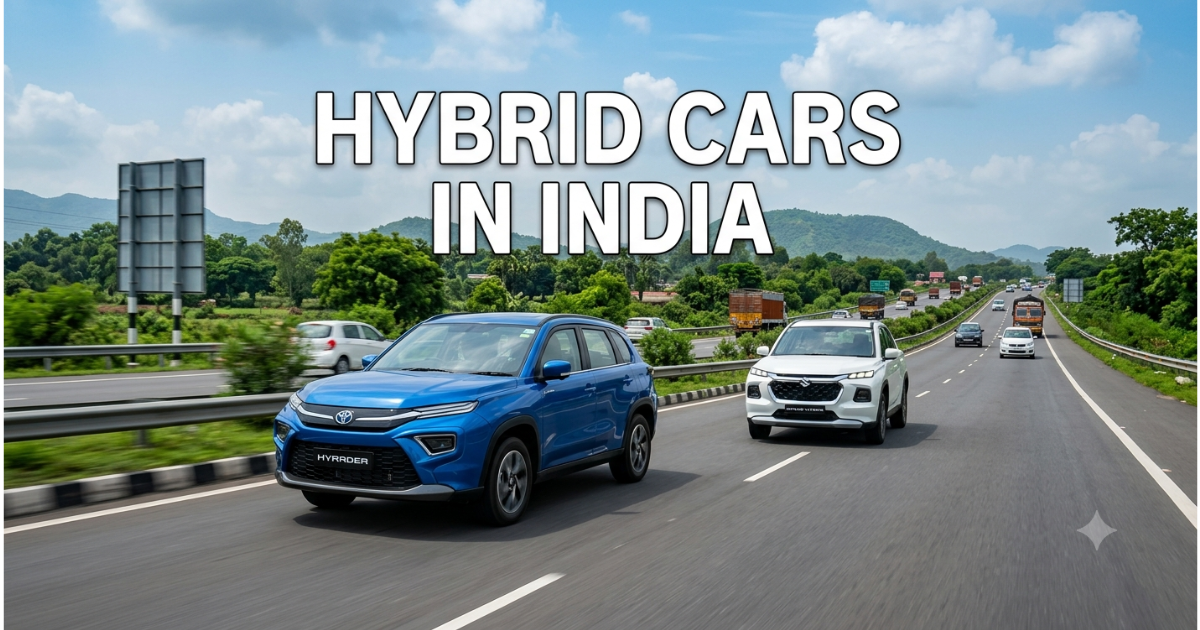
Starting at ₹10.77 lakh, the Maruti Suzuki Grand Vitara leans on electric energy at low speed to lift fuel efficiency. Good ground clearance suits Indian roads, and the cabin offers real comfort on longer drives.
That silent electric movement makes crawling traffic far less draining for daily commuters. It’s become a go-to among hybrid cars in India for small families wanting dependable daily use.
The Toyota Urban Cruiser Hyryder, starting from ₹10.99 lakh, shares the same bones but leans harder on the Toyota brand name. Its hybrid system manages city driving with a genuinely smooth driving feel.
Drivers chasing smooth performance and confident urban driving rate it consistently well. Both these SUVs push close to 27.97 km/l, making either one a smart everyday pick.
Moving up a size, the Maruti Suzuki Invicto is a hybrid MPV priced from ₹24.97 lakh to ₹28.61 lakh. It’s purpose-built for large families needing extended travel without losing fuel efficiency.
Its dual power system stays smooth across both urban driving and open highways. The spacious interior comfortably fits seven passengers for family vacations.
The Toyota InnovaHycross, priced between ₹18.70 lakh and ₹31.84 lakh, pairs a powerful hybrid system with contemporary technologies. It returns close to 23.24 km/l for buyers splitting time between personal use and business applications.
At the very top, the Toyota Camry, priced around ₹47.48 lakh, trades affordability for a full luxury hybrid sedan feel. It manages roughly 25.49 km/l while offering silent driving and confident acceleration.
High-quality materials and genuinely state-of-the-art technologies fill its spacious interior. For drivers chasing a true hybrid driving experience wrapped in high-end design, this model delivers driver comfort and passenger convenience in full, even though it sits on the expensive end.
Which Hybrid Car Should You Choose?
Honestly, the decision comes down to your financial capacity, everyday vehicle usage, and your specific needs. Buyers chasing economical motoring within hybrid cars in India keep landing on two familiar names.
The Maruti Suzuki Grand Vitara and Toyota Urban Cruiser Hyryder remain the two smartest hybrid vehicle options available. They balance price and features so well that they dominate most selecting conversations among first-time buyers.
For households needing genuine extended space or heavier operational capacity, other picks fit better. The Toyota InnovaHycross and Maruti Suzuki Invicto remain the better-fitted hybrid vehicle choices for that.
And for anyone chasing a true upscale automotive experience, the Toyota Camry stands out as the clear ideal vehicle. It gives drivers genuine luxury for that kind of purchase without stepping outside the hybrid category.
What Are Plug-in Hybrid Cars in India & Why Are They Trending?
A plug-in hybrid electric vehicle runs on a genuine dual powertrain, blending an electric motor with a petrol engine. The motor charges through an external plug, while the engine only steps in once the battery runs low.
India’s mixed city-cum-highway conditions happen to suit PHEV cars particularly well in daily life. A typical urban commute covering 35-40 KM can be completed entirely on electricity, meaning the petrol engine never fires once during that round trip — a growing trend among hybrid cars in India.
Plug-in Hybrid Cars List
The Toyota RAV4 PHEV leads globally as a genuine worldwide bestseller, delivering 65 km of pure electric range. The Hyundai Tucson PHEV is expected by mid-2026 with roughly 50 km of range.
The Kia Sportage PHEV sits comfortably in the mid-premium category at about 55 km. On the luxury side, the BMW X5 xDrive45e manages an impressive 87 km, and the Volvo XC60 Recharge brings 81 km wrapped in unmistakable Scandinavian elegance.
Difference Between Strong Hybrid Cars in India and PHEVs
The real split comes down to charging habits between two popular kinds of hybrid cars in India. A strong hybrid like the Maruti Grand Vitara or Honda City Hybrid stays entirely self-charging.
It offers only about 1-3 km electric range and never needs a plug at all. A genuine plug-in hybrid, by contrast, draws power from an external source and can stretch to 40-90 km of pure electric driving range, which is why reliable home charging matters so much.
How Do Plug-in Hybrid Cars Work?
Picture it like a smartphone resting on a power bank overnight in your driveway. You typically charge via plug for 2-4 hours at home to get a full charge.
From there, electric-only mode delivers silent, zero-emission driving for up to 40-90 km. Once that charge runs out, hybrid mode kicks in automatically as the petrol engine takes over smoothly.
Every bit of deceleration along the way feeds energy straight back into the battery through regenerative braking. Stop-start traffic across cities actually plays to a PHEV’s strengths, since frequent braking cycles recharge better than high-speed scenarios.
Upcoming Plug-in Hybrid Cars in India 2026
Timelines here are moving fast for this segment of hybrid cars in India. The Toyota RAV4 PHEV is expected Late 2026 around ₹48-55 lakh with 65 km of range.
The Hyundai Tucson PHEV targets Mid 2026 at ₹40-48 lakh for roughly 50 km. The Kia Sportage PHEV is pencilled in for 2026-27 at ₹38-46 lakh offering 55 km.
The BMW X5 xDrive45e stays Ongoing at a steep ₹90 lakh-₹1.2 crore for 87 km. The Volvo XC60 Recharge, expected as a 2026 expected update, is priced around ₹70-85 lakh for 81 km.
Final pricing hinges heavily on CKD assembly, since CBU imports attract duties crossing 100%. This pushes the overall hybrid car price upward, though the Kia Sportage PHEV and Hyundai Tucson PHEV offer the smartest value to range.
Which Car Is the Best Plug-in Hybrid?
The honest answer depends entirely on your lifestyle and daily commuting conditions. A city commuter covering under 50 km/day, and even a long-distance driver, will both find the Toyota RAV4 PHEV hard to beat.
A luxury buyer naturally leans toward the BMW X5 xDrive45e instead. Matching your buyer profile to your real needs matters far more than chasing the flashiest spec sheet.
Which Is Cheaper, a Hybrid or Plug-in Hybrid?
The upfront cost tells most of the story when comparing two types of hybrid cars in India. A strong hybrid stays lower in price with only about 1-3 km of electric-only range, needing zero home charging.
A plug-in hybrid costs higher upfront but stretches to 40-90 km of range. This is exactly why urban users with dependable charging gain more than no home charger users, and that single parameter should guide your call.
Which Is Cheaper to Run, a Hybrid or Plug-in Hybrid?
Running a strong hybrid across 1,200 km/month typically costs close to ₹3,600 in fuel, with ₹0 spent on electricity. The total per month lands near ₹3,600, or roughly ₹3.0/km.
A PHEV charged daily spends closer to ₹1,200 on fuel and ₹1,440 on electricity at about ₹8/unit. That settles near ₹2,640 in monthly cost, or roughly ₹2.2/km, adding up to nearly ₹11,500 annually saved.
Conclusion
Standing where the market is in 2026, the hybrid car market across India shows no signs of cooling off. Buyers keep drifting away from traditional petrol-powered cars toward something more balanced and future-ready.
The lineup now covers everything from practical economy SUVs to genuinely plush luxury sedan models. Cars like the Maruti Suzuki Grand Vitara and Toyota Urban Cruiser Hyryder prove hybrid cars in India don’t need deep pockets.
Both models offer strong hybrid systems loaded with advanced features without breaking the bank. The bigger takeaway is simple: hybrid vehicles let owners trim fuel expenses while keeping full driving comfort.
This is genuinely future-proof options territory, the kind of smart hybrid thinking worth paying attention to in 2026. It also opens the door to plug-in hybrid cars for buyers chasing extra power and range.
It’s a rapid development story rooted in stability, long-term vision, and everyday usability. If you’re still weighing your next buying experience, remember fuel efficiency and performance no longer force a trade-off.
A quick chat with Motorpedia can save serious time when comparing smart options across models. For Indian consumers, that mix of savings, comfort, and diverse elements of engineering makes hybrid cars in India one of the smartest electric-leaning purchases today.
FAQs
What are hybrid cars in India best known for?
Hybrid cars in India are best known for combining a petrol engine with an electric motor to cut fuel costs and emissions, especially in stop-start city traffic.
Which is the cheapest hybrid car in India right now?
The Maruti Grand Vitara Hybrid, priced around ₹19 lakh, currently stands as one of the most affordable hybrid cars in India.
Do hybrid cars in India need external charging?
No, most strong hybrid cars in India self-charge through braking and engine use; only plug-in hybrids require external charging.
Are hybrid cars in India cheaper to run than petrol cars?
Yes, hybrid cars in India typically deliver 20-28 km per litre, nearly double the mileage of conventional petrol cars, leading to real monthly savings.
Will cheaper plug-in hybrid cars in India launch soon?
A plug-in hybrid under ₹10 lakh isn’t expected until around 2030, so budget buyers currently rely on strong hybrids instead.